Monthly Archives: April 2013

Jupiterjenkins.com back in May?


Be careful what you wish for.

I was really looking forward to some time off.  But not this way.

I was scheduled for an eye appointment on April 24th.  The doctor found a tear in my retina.  He sent me to another specialist for later that afternoon for laser surgery.  That’s the good news.  The bad news is I am forbidden to read and that includes music – anything – until he gives me the okay.  So I had to bow out of rehearsals and even Sunday’s church service.

You may be wondering how I am doing this blog.  My lovely wife, Eileen, is taking dictation.

This actually works out good for her since one of her new duties at work will soon include blogging for the library.

library blog

Stay tuned for up-dates on that.  In the meantime, I am spending my time in a comfy chair, cat on my lap, listening to records or watching tv.  Tv watching is okay because there is no tracking of the eyes as in reading.  This figures because I’m not that fond of tv but I do like Netflix.  So I guess I’ll be catching up on movies and documentaries.  Life is still pretty good but I will miss reading and practicing.  It’s a small price to pay if my eye heals completely.

DSCF3778

PS from Eileen:  Oh, no!  Now I’ll have to do the laundry, grocery shopping, the bills….  !  Steve will have a hard time sitting still but I’ll do my best to keep him resting as much as possible.

*****

Lost in Space – NYTimes.com

Cool, eh?  I just showed Eileen how to put a link on my blog.  I read this article on my phone in the doctor’s office just before they told me I should not be reading anything.  Ironically it’s about gathering information on breaking news on-line.  It’s something I won’t be doing for quite a while.

*****


ahhhhh


The dance department is done with me for the semester. Ahhhh. Last night Eileen and I went out for drinks and dinner to celebrate. Her coworkers protested that it wasn’t Thursday and wanted to know if we were going out that night as well. Eileen told them probably. Life is rough.

My treadmill seems to have died. I was chatting with Sarah my daughter in England when it just stopped yesterday. I am planning to do different kinds of exercise until I can get it fixed or replaced.

Yesterday I spent a good amount of time at the church copy machine reproducing a Gilbert and Sullivan cantata called “Trial by Jury.” I picked up a single copy at the college library book sale. I’m pretty sure it’s out of copyright. I made fifteen copies for my choir (78 pages on 19 sheets folded). I have to assemble them today.

File:Trial by Jury - curve bend.jpg

I am planning to surprise the choir (possibly this evening) with it and suggest that we might sing through it for the bloody hell of it.

I am pretty sure very few if any choir members read this blog so the surprise is pretty safe. Anyway it’s not that big a deal if someone knows I’m planning on it.

It did take quite a bit of time. The music is pretty easy and I think with me at the keyboard doubling some parts we can sing through it a few times in the last rehearsals and possibly at the end of the year party.

Today I have church and doctors appointments. This morning I see the eye guy. Maybe I’ll find out more about my little floater friend in my left eye. This afternoon I have a dentist appointment for a regular cleaning. In between I meet with my boss and prep for tonight’s rehearsals.

At this point I have nothing scheduled for Thursday or Friday. I can’t believe it. I do have to muster some energy and get seriously started on clearing out junk from the main floor so the contractor can come and renovate. I probably have mentioned here that Eileen and I are planning to convert the main floor into a living space for our rapidly approaching old age. This means we need a full bath and laundry facilities on this floor. We are set to have this done as soon as I can get the rooms ready. I will hire a guy I know from church to help me with the heavy lifting.

But in the meantime I plan to do some more goofing off (which in my case means a lot of reading and practicing).

Life is good.

******

Steven Heller at Design Indaba 2013 | Design Indaba

This links to a video of a designer talking about his passion for graphic design. I haven’t watched the whole thing but it looks good.

*****

O’Connor’s Regrets – NYTimes.com  Barney Frank letter to the editor

I do admire gadfly extraordinaire Barney Frank.

*****

Dante’s ‘Divine Comedy,’ Translated by Clive James – NYTimes.com

A new translation. Looks interesting.

*****

John le Carré Has Not Mellowed With Age – NYTimes.com

More PR for le Carre.

And here’s an article he wrote after Sept 11 which drew fire. I like it.

John le Carre : The United States Of America Has Gone Mad

*****

Orzo With Peas and Parsley Pesto — Recipes for Health – NYTimes.com

I keep bookmarking recipes. Maybe now that ballet class is over I’ll actually do more cooking.

*****

health report and sound as music


Little health report for those interested put at the top of the blog so eyes don’t glaze over in the midst of my rambling and miss it:

I decided yesterday to make an appointment with an eye doctor to take a look inside my eye. I am resigned to the fact that something is wrong with it, but it would be good to know more about that. I am expecting the doctor to be able to either tell me that my retina is in the process of detaching or maybe the odds of how long before it does. Or maybe something more hopeful. As I mentioned a couple days ago I have a new pretty dramatic floater which is beginning to feel vaguely like a familiar (spirits that attend the magician).

Since one of the reasons I write (but not the only reason) is to update my family and interested friends I thought I would mention this here.

Glenn Gould’s radio broadcasts are available on record and on Spotify. I listened to the entire “Idea of the North” last night. Googling reveals it is also available on a CBC site. It uses disembodied voices talking about many aspects of the northern areas of Canada. Gould has mixed them like counterpoint so that the voices sometimes sound simultaneously. But through the clever and simple use of attenuating one or more at time the ear is drawn to phrases and comments much as it is in a fugue or some other piece of counterpoint. This is Gould’s technical point. But not his content. The content is about vastness and solitude, about Canadians and indigenous peoples of the place. It is truly a wonderful piece of music to my mind.

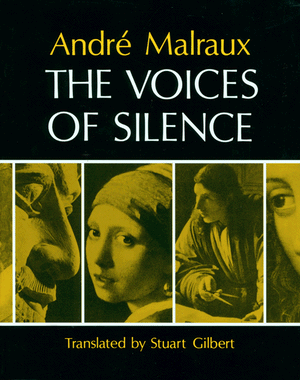
My used paperback copy of  Voices of Silence by André Malraux arrived in the mail yesterday.

Gould claimed Malraux along with McLuhan as strong influences even though his biographers say that his thinking is more original than derivative.

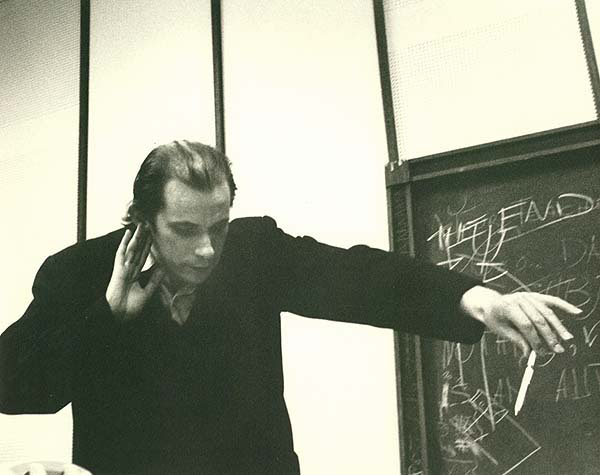
Glenn Gould and McLuhan

Gould and Marshall McLuhan

Malraux coined the term “Museum without Walls.” Writing in the fifties he is parsing out the effects of technology on the visual arts. The “museum without walls” instantly reminds one of the interconnectedness of the world right now. But Malraux was trying to understand the impact of dissemination of images via photography, especially images of works of art and how it changes how we see them.

From there it’s not hard to see how Gould would take this idea into the world of recording music.

Gould obviously buys into what I previously thought of as a John Cage concept: that all sound can be understood musically. Or that there are no barriers between listening to music and any other sound.

The makers of the movie “Thirty two short films about Glenn Gould” wordlessly and artfully show this. The actor playing Glenn Gould drives up to a truck stop restaurant. He is greeted by the waitress who asks if he wants his usual. He then sits and we watch him listen to the conversations around him. This is the whole scene. He smiles and is obviously enjoying the counterpoint of the voices. Very cool.

ideas anyone?


In my reading about Glenn Gould, someone referred to him as “in love with ideas” I like this and am vain enough to think that I have a small share in this quality.

Christopher Small develops the concept that music is a story, a narrative. Upon looking at the score of my work based on T. S. Eliot’s “Ash Wednesday” a composition teacher commented that he hadn’t thought of what I had done, simply state ideas and not develop them. In this multi movement work, many movements are only measures long.  It is scored for SATB, Soprano and Tenor soloists, guitar, flute, harpsichord and cello (if I recall correctly).

This morning it occurred to me that this little composition might have some relation to the fact that I see myself as an “idea” person. I seem to be able to come up with alternate scenarios and possibilities be they improvised musical ones or thoughts to present to a church committee.

As an implementer I can exhibit qualities of persistence and clarity but I think I lack an attractive personal charisma which is so important these days for leadership.

The composition teacher who looked at my manuscript seemed to be reluctant to consider me as a composition student. I never asked him to do so. He was one of my undergrad music theory teachers.

He and I never really hit it off. I was stuck in a kind of theory zip class or one that profs love to call “remedial.” Not sure how I got there but I suspect it was a mandatory class at Wayne State U where I was attending. The teacher was trying to convince us of the necessity of knowing the basic music languages of key. I agreed with him totally. I must have been smiling because I think he perceived it as  a smirk. He came to my desk as he wandered and lectured. He looked me and sarcastically said something like “You think you don’t need to know this stuff, eh?” He embarrassed me.

I boned up on the key signatures and at the next class when he asked us to identify a key, instead of waiting to be called on I just gave the answer out. I continued to do this until he asked me to stop.


I guess we hit off poorly.

Anyway, I was (and probably still am) thirty for musical understanding and collaboration.

So when he made the comment about “Ash Wednesday” I thought I would take it to heart in my next work which was a suite for five instruments (Flute, Oboe, Guitar, Cello and Harpsichord). I labored long and hard, composing and rehearsing it for one of my undergrad recitals. The movements were more typical length and I based them largely on my understanding of baroque suite movements (Allemande, Sarabande, Gigue).

The composition teacher attended. His comment was it was too long.

Oy.

*****

Danes Rethink a Welfare State Ample to a Fault – NYTimes.com

There are definitely limits to safety net thinking, although I tend to err on that side myself. Helpful insights in this article.

*****

Questioning the Mission of College – NYTimes.com

U of T and Texan leaders acts out some basic differing ideas about why one takes the trouble to learn stuff.

*****

President Obama Is No Bully in the Pulpit – NYTimes.com

Some hard insightful comments from Dowd on Obama’s failure as a pragmatist.

*****

Sweden’s Closet Racists – NYTimes.com

Personal point of view of what it’s like to be on the receiving end of prejudice. Recommended.

*****

In Memory of a Friend, Teacher and Mentor – NYTimes.com

Philip Roth writes about an extraordinary teacher in his life.

*****

BBC News – A Point of View: Science, magic, and madness

I love the way this writer is employing British idioms such as referring to the incoherent as “barking.”

*****

John le Carré: ‘I was a secret even to myself’ | Books | The Guardian

I have read most of le Carre. Not surprising that his books do not reflect much in the way of how things are done at MI5. They are after all very romanticized views of life if also a bit dark.

*****


glen gould and an eye floater


I seem to be on a Glenn Gould kick. He keeps popping up. Last night Eileen and I watched Slaughterhouse Five on Netflix. I had mentioned earlier that Gould had done the soundtrack. I think we were talking about Dresden and the war. Eileen said she didn’t remember ever watching the movie. I knew I had read the book at least once. At any rate we settled in and watched Billy Pilgrim as ably realized by the actor Michael Sacks.

Some of the scenes looked familiar to both Eileen and me so it’s likely we have watched it before. Memory is a treacherous thing and false memories do abound. But I am willing to bet we both had seen it before. It is however the first time I ever watched it thinking about Glenn Gould.

There was a scene in it that the maker of “Thirty two short films about Glenn Gould” must have had in mind (partially) when he filmed the first and last short film which show Gould emerging (and then disappearing) into a winter snow landscape. Billy Pilgrim also is shown solitary in a winter landscape at one point.

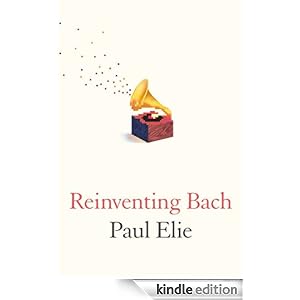
Gould also plays a role in Paul Elie’s Reinventing Bach which I keep slogging away at.

It makes sense that he would since Elie seems to be determined to leave no stone unturned regarding Bach in the 20th century. In that story, Gould would have to be mentioned as well as Casals, Schweitzer, Stokowski and numerous others.

Well it’s Sunday morning and I need to get moving.

I am attempting to get used to having a long new strand of floating protein in my left eye. Friday morning in class I noticed something in my peripheral vision. I watched with horror as over the next hour and half  it gradually extended across my sight like a thin hydra dancing with what seemed like a life of it’s own.

My reading tells me that unless accompanied by other symptoms it signifies nothing other than a nuisance (like my tinnitus I guess). Unfortunately my reading also tells me it doesn’t go away unless one undergoes surgery (which doesn’t have that great a record of success).

*****

For Leonard Cohen, What Goes Around Comes Around | culture | Torontoist

So Leonard Cohen interviewed Glenn Gould early in both of their careers. He then received the Glenn Gould Prize in his old age.

*****

Beet Greens and Rice Gratin — Recipe for Health – NYTimes.com

Mmmm. this looks good.

*****

Karl Berger’s Improvisers Orchestra at Shapeshifter Lab – NYTimes.com

Improvising groups fascinate me.

*****

Eye Floaters: Causes, Symptoms, and Treatment

My source of info.

*****

zero to one, both and


Glen Gould in his interview of himself published in High Fidelity magazine in 1974 makes the following comment (g.g. is the imaginary interviewer, G.G. is the Glen Gould persona, both were created by Glen Gould):

*****

g. g. :  Mr.  Gould, I don’t feel we should allow this dialogue to degenerate into idle banter.  It’s obvious that you’ve never savoured the joys of a one – to – one relationship with a listener.

G. G. :  I always thought that, managerially speaking, a twenty – eight – hundred – to – one relationship was the concert – hall ideal.

g. g. :  I don’t want to split statistics with you.  I’ve tried to pose the question with all candour, and –

G. G. :  Well then, I’ll try to answer likewise.  It seems to me that if we’re going to get waylaid by the numbers game, I’ll have to plump for a zero – to – one relationship as between audience and artist, and that’s where the moral objection comes in.

g. g. :  I’m afraid I don’t quite grasp that point, Mr.  Gould.  Do you want to run it through again?

G. G. :  I simply feel that the artist should be granted, both for his sake and for that of his public – and let me get on record right now the fact that I’m not at all happy with words like “public” and “artist”; I’m not happy with the hierarchical implications of that kind of terminology – that lie should be granted anonymity.  He should be permitted to operate in secret, as it were, unconcerned with – or, better still, unaware of – the presumed demands of the marketplace – which demands, given sufficient indifference on the part of a sufficient number of artists, will simply disappear.  And given their disappearance, the artist will then abandon his false sense of “public” responsibility, and his “public” will relinquish its role of servile dependency.

*****

Thus “zero – to – one” may describe the isolation one has when listening to a recording. The creator’s active role accomplished prior to the listening is thus reduced to no role at all.  Where recordings are concerned the only living actor is the listener.
This is important because we all access music via recordings. It could easily out weigh any other means of accessing music for most people and possibly most musicians.

In contrast Christopher Small maintained that music was a social transaction. Relationships in all their messiness was what music was about for him.
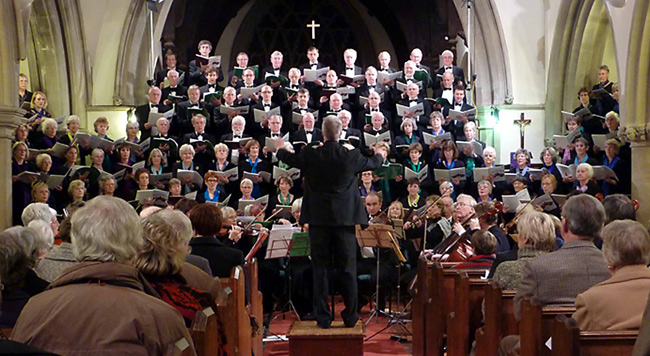
Music is an activity.
Small questioned the idea of repeated listenings to music when the music is understood as a story. He likened symphonies to novels.

The first hearing (and reading) is often the most engaging. In subsequent hearings and readings the bare bones of structure and form may emerge. These concepts might be important to the crafts person who might be interested in creating such stories, but they are different from experiencing the story.
But what of repeated experiences that begin to take on a comforting familiarity. This is more in the realm of ritual. Christopher Small was also very interested in ritual. He asked questions about the ritual of public performance in the classical music world of his time (late 20th century). He saw it as moving away from human meaning and experience. In that he was surely correct.
For me the idea of music encompasses all of this: isolated listening to recordings, participation in live performances and, of course, ritual.

When a poem, story or song becomes so familiar we can “sing along” and take comfort in what is coming next, it seems to me that we are experiencing that security that ritual can provide.

When we are disturbed from our complacency to new insights by such experiences whether initial or repeated again I think that ritual can still be seen as in effect. This blast of light and insight relies on the conventions of ritual expectation but also provides the wonderful experience of “aha” or deep emotional response.

It can occur in music in any of the experiences mentioned above (listening to a recording, experiencing live music for the first time or for repeated experiences).

*****

Wringing out a washcloth in space

I think the astronaut in the video is the same guy who performed on guitar from outer space with earth musicians  live remote recently.

*****

Top U.N. Rights Official Denounces Iraqi Executions – NYTimes.com

When the state kills, evil is in the room. Just my opinion.

*****

Is China Changing Its Position on Nuclear Weapons? – NYTimes.com

Yikes. China reserves first strike options at least in its rhetoric.

*****

bursts of light from a composer and two poets


I only five more days of ballet classes. Possibly less, if any are canceled last minute. I still enjoy the work, but am ready for some time off.

Caroline Shaw,this year’s winner of the Pulitzer Prize in music, earned her living after getting a masters in music “accompanying ballet and modern dance classes on piano, violin and percussion…” (Caroline Shaw, Award-Winning Composer – NYTimes.com)

I listened to the recording of this piece.

I like that Shaw doesn’t think of herself as anything but a musician.

I also like this piece quite a bit (both the live performance above and the studio recording which is on Spotify).

Her comments and descriptions in the above link are illuminating. She sounds like someone I would want to know and work with. I don’t say that too often about musicians.

I was surprised to open the pages of my new New Yorker and find two poets I have been reading in it. I rarely seem to like the poems the  New Yorker publishes. For a few years I submitted poems myself. I hope it’s not just jealousy. In fact, I was thinking as read Michael Robbins and Anne Carson’s poem in this issue, that it could be a sort of lack of poetical context. Reading entire books of poetry one gets a larger rhythm going than just one poem. The poetry is sort of in dialog with itself.

One poem on a page in a magazine has to sort of wing it alone so to speak. Just burst into your head and do its work. I usually read the first couple of lines and see if it draws me in at all. I do the same with the New Yorker ficition. Occasionally I am drawn in.

I find Robbins work to resonate with phrases from popular culture that twist into new meanings. I like that. Ann Carson I am still trying to figure out. I’m about halfway through her Decreations. It’s not one of her major works I gather. But I am finding an occasional burst of light in it.

*****

The Finding – U.S. Engaged in Torture – NYTimes.com

Letters in response to this story.

*****

‘The Dispensable Nation,’ by Vali Nasr – NYTimes.com

Review of a new book that critiques Obama’s foreign policy.

*****

Of Judges and Judging – NYTimes.com

Linda Greenhouse is supposedly retired. She has taught me a lot about the Supreme Court with her reporting. She’s always worth reading.

*****

The Art of Filippo Minelli – NYTimes.com

He paints words outside, words that resonate out of context.

*****

How the Pre-Penicillin Era Could Help Combat Antibiotic Resistance – NYTimes.com

History of meds. Probably holds future promise after exhausting antibiotics usefulness.

*****

Coelacanth DNA May Tell How Fish Learned to Walk – NYTimes.com

I love this shit.

*****

Digital Public Library of America

online as of yesterday.

*****

it’s raining


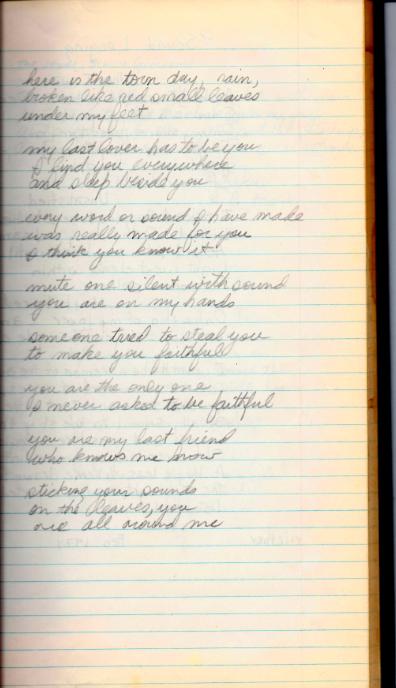
I’m listening to the rain pouring down in the early morning darkness in Western Michigan. I love the rain. I wrote a poem as a young man which basically addresses the rain as muse.

rain02

here is the torn day, rain
broken like red small leaves
under my feet

my last lover has to be you
I find you everywhere
and sleep beside you

every word or sound I have made
was really made for you
I think you know that

mute one silent with sound
you are on my hands

someone tried to steal you
to make you faithful

you are the only one
I never asked to be faithful

you are my last friend
who knows me now

sticking your sounds
on the leaves
you are all around me

*****

Thus it has been for me all my life. My body and mind relaxes when it rains. I love to walk in it.

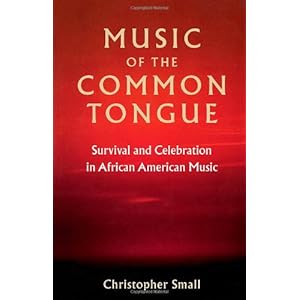
I purchased a Kindle book this morning by Christopher Small: Music of the Common Tongue: Survival and Celebration in African American Music.

He mentioned it in Musicking and I was intrigued. Apparently it’s basic idea is that the most important music of the Western tradition in the 20th century is African American. I’m not sure about what is most important, but this body of music is an extremely important and influential one for me.

Last night in my Kids Choir rehearsal, I had them sing “Go Down Moses.”

We have been talking about hymnody, words versus tunes. I have been trying to get my three kids to think about who wrote the words to a hymn and where did the tune come from.’

Last night I learned that my kids were only beginning to learn about slavery in America. But their imaginations quickly fired up and drew on their lessons and described vividly what it’s like to be someone’s property.

We talked about the relationship of the story of Moses and the Israelite slaves to the American slaves brought from Africa.

They liked singing the song I think.

Music of the Common Tongue was cheapest as a Kindle book. Usually I can pick up a cheap used edition of a book on Amazon. But in this case $12.71 (the Kindle price) was cheaper than any of the used ones available.

Yesterday was my penultimate crazy Wednesday. One more and I will be done with have both an 8:30 AM class to play for and an evening full of church and rehearsals.

I only had five singers at the adult choir rehearsal. It is discouraging how thinly people commit themselves these days. Or maybe I should say how far they spread themselves over commitments, since most every person missing was honoring a different commitment like symphony orchestras or other important things.

It takes energy to pull together a small group and have them leave feeling like their time was spent in a worthwhile fashion. I hope I accomplished that last  night. I know I tried.

I did find time to make a few videos of myself playing organ. These can be helpful if humiliating. Here’s one.

I put this up on the Grace Music Ministry Facebook page yesterday. It is my prelude for Sunday. Most of the notes are there I think. I also think that it helps to hear a piece a few times if  you’re going to hear a live performance. My hope is that some of the church Faceboookers might listen and then be more prepared to hear it more clearly Sunday. Or not.

Also I am meeting tomorrow with my friend Rhonda for her thoughts on this piece. She has played some CPE Bach, maybe even this one, so I am hoping she will  answer a couple questions and critique my playing.

I have a long but pleasurable and rather easy day ahead of me. Two ballet classes, a trio rehearsal, some organ rehearsal, then date night with my lovely wife.

Need I say it? My life is good.

*****


& now a bit of church music shop talk plus links


h306

Getting this up a bit late today. Ah well.

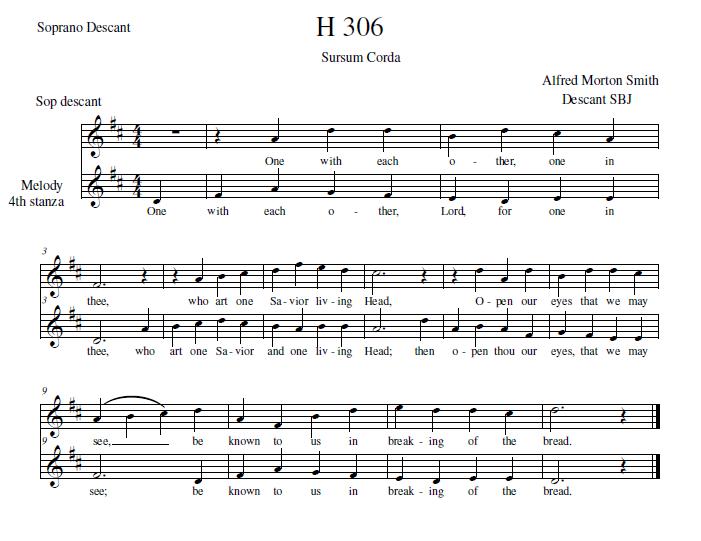
Last Sunday we did a soprano descant I composed the day before. The hymntune was Sursum Corda. The text in the Hymnal 1982 was “Come, risen Lord, and deign to be our guest.” From a cursory glance both of these (tune and text) were in the Hymnal 1940 but were not paired.  I think the hymn tune melody is an example of the simple elegance sometimes achieved in the Anglican tradition. And I was happy with my little descant.

I have put up a Jpeg of it here. If you read this and want a PDF, let me know.

I keep composing.

I don’t  mean to necessarily. I have ideas but no real time to work on them. And then I was rehearsing this hymn and I heard a lovely little descant that was not too high and would match the tune nicely.

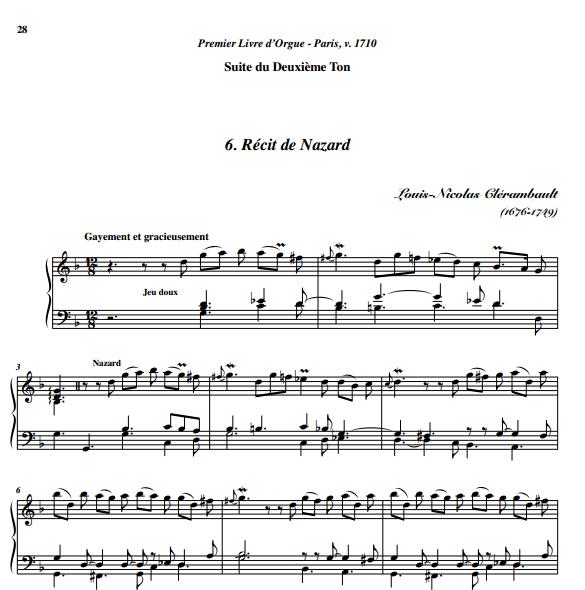
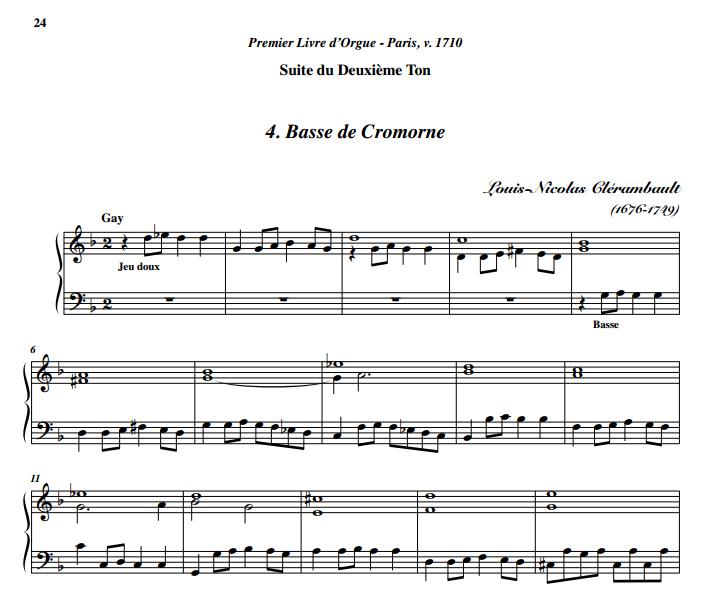
I chose music for a week from Sunday yesterday. I am planing to play a couple of movements from Clerambault’s suite on the second tone.

“Recit de Nazard” for the prelude.


clerambaultrecitdenazard


“Basse de cromorne” for the postlude.

clerambaultbassedecromorneI played the entire suite on an undergrad recital. I do like the music.

*****

The Reading Brain in the Digital Age: The Science of Paper versus Screens: Scientific American

This is the best article I have read on this subject. It asks some very astute questions and cites some cool studies.

I also find it kind of hilarious that it will not display a single page to be read. Flipping between frames  doesn’t allow me to refer back into an article, something I do regularly.

*****

For the Elderly, Diseases That Overlap – Interactive Feature – NYTimes.com

This has some fun moving pictures that illustrate the statistics.

*****
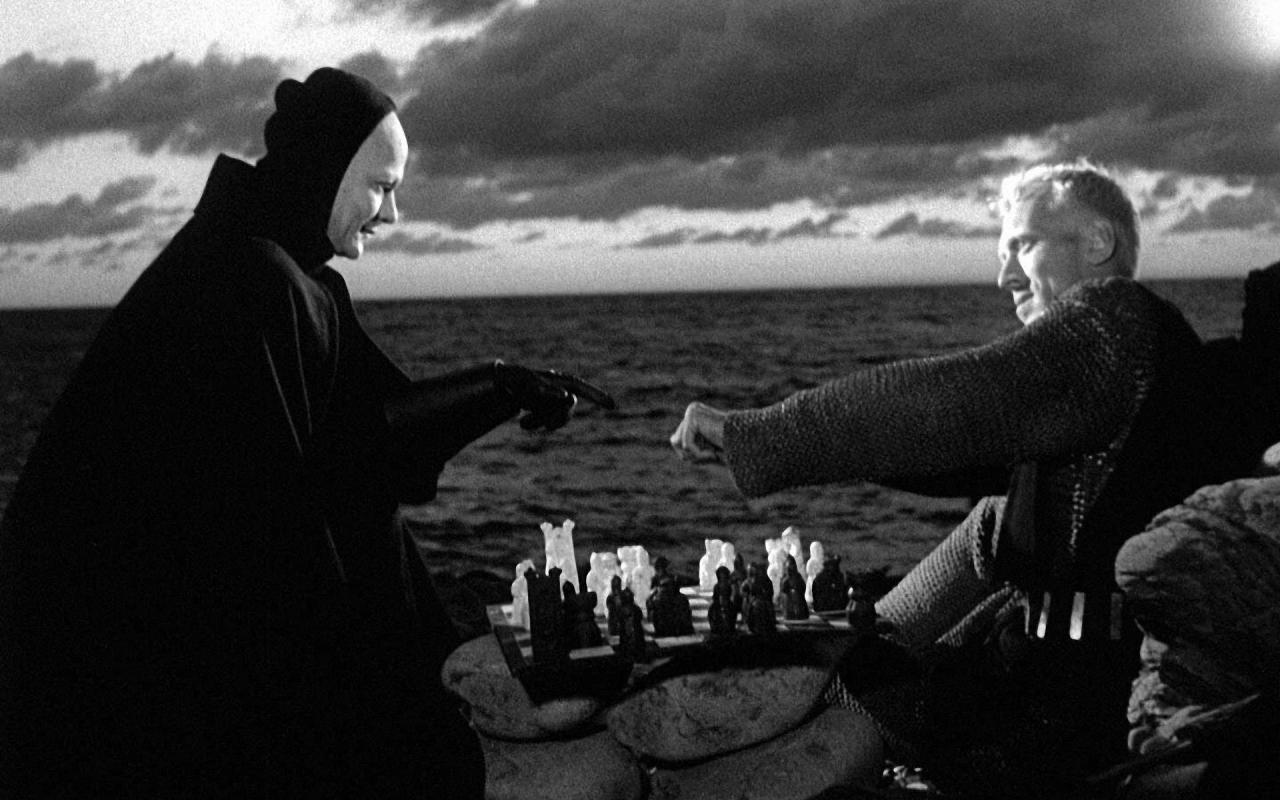
What a Fighter Jet Could Buy 60 Years After Eisenhower’s Chance for Peace Speech – NYTimes.com

Guns or butter. I think Eisenhower had an opinion that would not be popular now.

*****
Dr. King’s Righteous Fury – NYTimes.com

This makes King’s voice more clear and sheds some of the silly nostalgia that has been building around his leadership.

*****

U.S. Practiced Torture After 9/11, Nonpartisan Review Concludes – NYTimes.com

Sooprise. Sooprise. Torture really is evil. My country really did it. Time to change the rules back.

*****

Hunger Striking at Guantánamo Bay – NYTimes.com

Speaking of evil. Terrible things being done to people like incarceration without possibility of trial.

*****

Avoiding Emergency Rooms – NYTimes.com

The greatest country in the world has no clue about health care.

*****

Live Music Soothes Premature Babies, a New Study Finds – NYTimes.com

Yay live music!

*****

Judge holds self in contempt for his smartphone | Michigan Radio

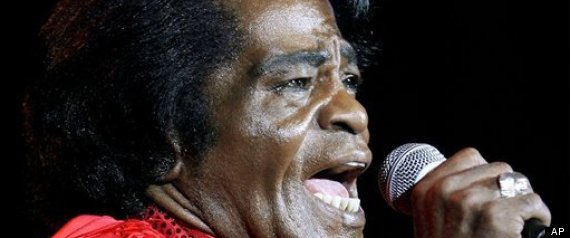
For some reason this makes me think of James Brown.

” Sometimes I feel so nice, good Lord! I jump back, I wanna kiss myself! I’ve got soul, huh, and I’m super bad, HEY!”

*****

Planet Pyongyang – Newsweek and The Daily Beast

Some warnings about North Korea you don’t hear so much.

*****

Turkish Pianist Sentenced for Twitter Postings – NYTimes.com

This makes me crazy.

*****

A little shop talk about CPE and JSB


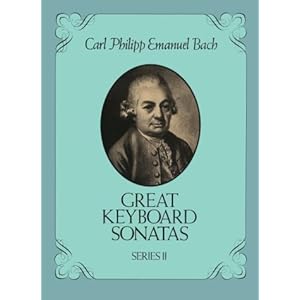
I was surprised yesterday when I read that CPE Bach (Johann Sebastian’s sons) composed many of his piano sonatas as a young man under the watchful eye of his father. I know that JS Bach was aware of the turn of music to the clearer and lighter pre-gallant music style. You can even see this in some of his works as he occasionally steps away from counterpoint and introduces beautiful homophonic based melodies.

I own five volumes of CPE’s keyboard sonatas (I guess its six counting the organ book I just bought).

Two of these are the Dover collections.

Like all Dover books these are reprints of older editions. The sonatas have been rearranged chronologically. They are drawn from Le Trésor des pianistes (volumes XII and XIII) by Aristide and Louis Farrenc (1861-1874).

The first volume is mostly of sonatas written before the death of his father. Yesterday I played five of CPE’s six so called “Prussian Sonatas.”

It fascinates me to think of father and son composing away in such wonderful yet different compositional voices.

I have three volumes edited by Eiji Hashimoto.

They are grouped into three volumes originally published in CPE’s lifetime in 1760, 1761, 1763.

I compared these more scholarly editions by Hashimoto to the first volume of my Dover CPE and found no overlap. This is a lot of music. When I purchased the Hashimoto editions, I’m sure I played through most of this material.

CPE is an important figure in music if for no other reason than his wonderful Essay on the True Art of Playing Keyboard Instruments. In this volume he is quite articulate about how music should be performed on keyboards. He does talk about his father. It’s not always clear how applicable all his comments are since they are sometimes vague or seemingly contradictory.

I remember when I first read this book thinking about the fact that I was pretty sure Glenn Gould read this. Gould’s interpretations are hardly in the historical fashion. But I do see influence of sources like CPE’s rather lengthy tome on his interpretation.

The Langlais edition of the organ sonatas I purchased is not that scholarly. But it is a practical performing edition and I am finding the music quite delightful.

I’m learning a movement to perform this Sunday as the prelude.

The”Prussian” sonatas I played through yesterday are dedicated to Frederick the Great who was CPE’s boss and was himself a flute player.

Published in 1740 the year Frederick ascended to the throne of Prussia, they appear two year after CPE had arrived in Berlin to join the august company of musicians in the young Frederick’s court.

Here’s a famous painting done in 1857 (many years later) of Frederick playing with his musicians. CPE is seated at the harpsichord. He had arrived two years earlier as I say to join Quantz, CH and JG Graun, Franz and Johann Benda. All these men were name brand musicians at the time. Quantz and/or the Grauns probably got him the gig. He was young and had only the Bach name going for him. I mean besides his considerable talent which I like to speculate he began to display in the lovely “Prussian” sonata group published a couple years later.

An interesting note from The New Grove Bach Family indicates that the young CPE was not paid as much as his confreres. “A budget list of 1744-5 in Frederick’s hand shows … 300 thalers (for CPE), as against 2000 each for Quantz and CH Graun, 1200 for JG Graun, and 800 for Franz Benda.”

The New Grove Bach Family goes on to point out that “In the same, season, the leading castrato received 3000 thalers.”

The castrati were the Justin Biebers of the time.

*****


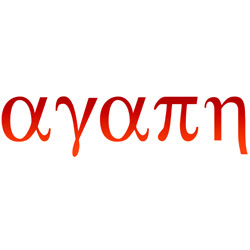
agape, phileo, eros


For some reason I woke up this morning thinking about whether people find life challenging or comforting. Working in church work, I do see people approaching the community seeking comfort more than food for thought.

Take the gospel yesterday. It was the story of Jesus asking Peter three times if he, Peter, loved him. He does this after the ressurection echoing Peter’s three denials of him before his death.

At  one point I taught myself a little Greek. I was interested in Homer but the only learning tools I could find at first taught New Testament Greek.

Reading this story in the Greek in which it was written, I was surprised that Jesus and Peter are using different verbs in this exchange. Jesus is asking Peter if he “agape”s him. Peter replies, Lord you know I ‘phileo” you.

Agape is a complex word. I associate it with God love. The way a god would love his creation or his creation would love him. It is also sometimes defined as selfless love.

Phileo on the other hand is clearer. Affection, friendship, brother and sisterhood seem to be covered by its usage.

Then there’s eros. It covers the physical expressions of love. It seems to me to be deeper than the way Western society usually thinks of sex. It can also indicate a connection to life. For me I think of the potency of meaning when I think of sexuality and eros.

In the Bible story, Jesus switches verbs in his third question from agape to phileo. Peter is troubled but still responds with the phileo verb.

*****

Dan Gilbert’s Quest to Remake Downtown Detroit – NYTimes.com

I lived in Detroit for a few years. It’s demise continues to fascinate me.

*****

Tensions Turn Violent at Guantánamo Prison – NYTimes.com

I find it frustrating that the USA has turned its back on so many of its founding principles (like speedy just trials).

*****

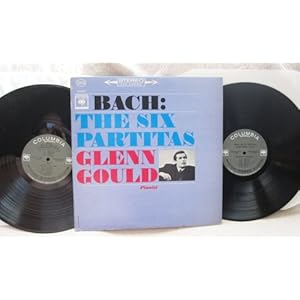
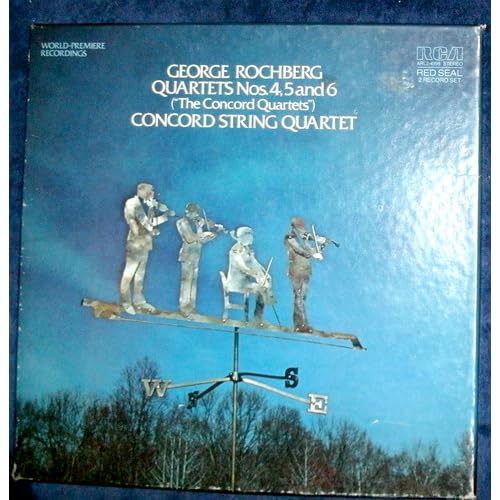
salvation vinyl


Apparently some classical music radio station dumped a bunch of records at Salvation Army. I was at the one on James street if you’re local and interested. There must be thousands of records for sale.

I picked up about twenty or so on Friday.

Eileen had the day off and wanted me to do some clothes shopping. Recently I had a woman give me twenty dollars on the street. She handed it to me wrapped in a note, so I didn’t realize she was doing so at the time. Eileen (and Rhonda) seem to think that I looked like a homeless person to this woman. Eileen ascribed some of this to my ragged winter coat.

So anyway we went shopping and at one point were at the Salvation Army.

I was amazed at the recordings that were for sale.

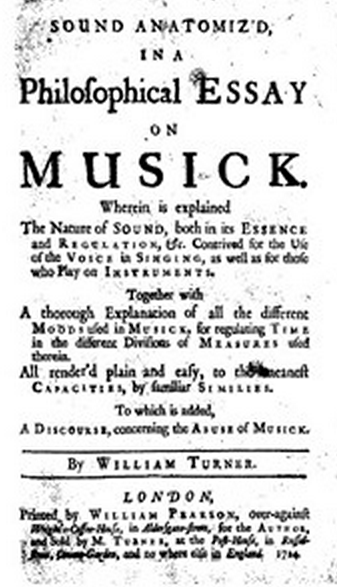
The records above are ones I purchased that I chose randomly to google and put up some pics of.

Yesterday I was wondering just how many Glenn Gould recordings I already own, since I have been thinking of him. I pulled out this one from my collection.

I put it on the turntable while I was doing bills. I was shocked when I heard it and realized how much influence  Gould’s aesthetic has had on me. Not that I can play like he does, but his understanding of the music, especially Bach, has been a prism through which I see much of Bach’s work.

This particular recording was one I chose to use to help my kids move from one living space to a new one. As the move approached I played the Bach record frequently. It’s a happy little thing and Gould plays it with exuberance.

Then when we moved to the new digs, I continue to play it. I was hoping it would provide some aural comfort in midst of the chaos of being uprooted. At any rate, it is a recording I love.

Serendiptiously yesterday I arrived at the section of the book, Reinventing Bach, where Paul Elie describes how Bernstein and Gould met and collaborated on this very recording.

*****

Rights Groups Question Legality of Targeted Killing – NYTimes.com

I was glad to see this happening. Not sure it will make a difference, but I do believe that drones raining down and killing people is immoral.

*****

What the Brain Can Tell Us About Art – NYTimes.com

An author and scientist shares his historical and philosophical understanding.

*****

Tell the Truth About the Arms Trade Treaty – NYTimes.com

This UN stuff keeps happening. I think it might be under the radar in TVland USA.

*****

Remarks by the First Lady at the Joint Luncheon Meeting: Working Together to Address Youth Violence in Chicago | The White House

Michelle Obama puts her political cred on the line. Rush Limbaugh does not approve. But I do.

*****

United Arab Emirates’ Laws Ensnare a Doctor – NYTimes.com

This is a scary story. The UAE tried this doctor in absentia. He didn’t know it and got busted passing through the country.Yikes.

*****

socially constructed music


musick

In his book Musicking Christopher Small writes an “Interlude” entitled “Socially Constructed Meanings.” Christopher Small extends his idea of music as a verb to music as inter-relationships.

“If we think of music primarily as action rather than as thing and about the action as concerned with relationships, then we see that whatever meaning a musical work has lies in the relationships that are brought into existence when the piece is performed.”

He goes on to say that the “relationships are of two kinds: those between the sounds… and those between the participants.”

It’s good to remember that Small’s notion of participant in music is much larger than the trio of composer, performer and listener. It includes those who make the instruments, set up chairs, made the building in which the piece is performed, in short any person with any conceivable connection.

Small sees relationships both sound and interpersonal as “dramatic, which is to say, they articulate tensions and relaxations, climaxes and resolutions, developments and variations” in which sound parallels human relationships.

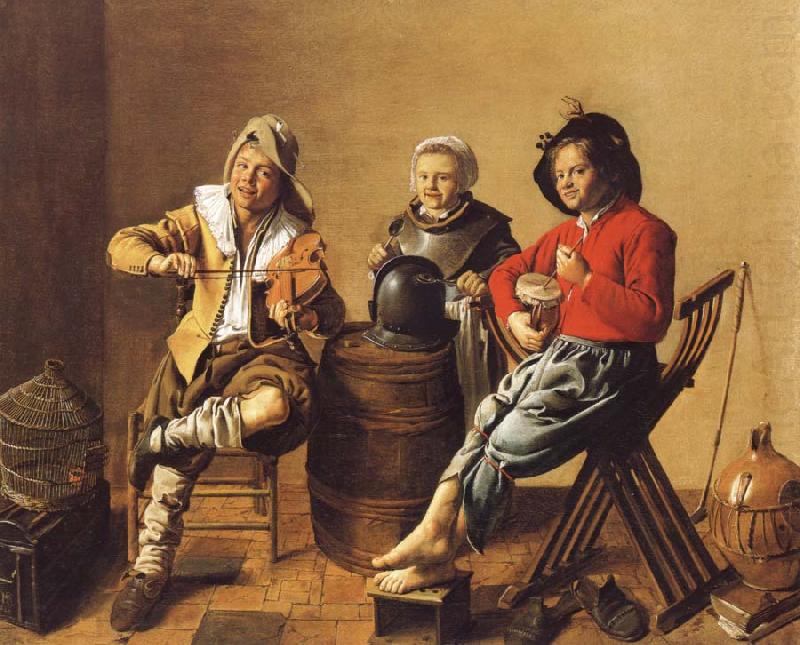
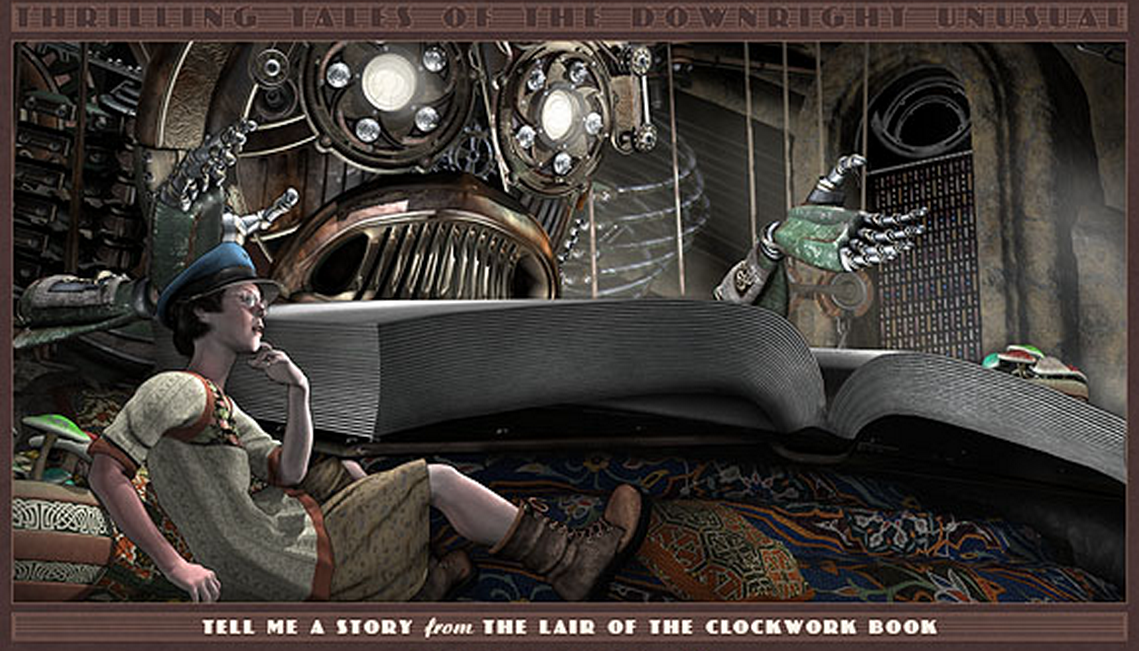
This all quickly falls under a rubric of story telling.

tellmeastory

So Small sees music not as the most abstract of the arts but as a very concrete expression of human relationships and story.

It’s probably important to recall that Small is not speaking just from a Western tradition point of view. He enlarges his thinking to any music done by any human beings and then circles back around to observe, understand and comment on how we think about and do music in the West.

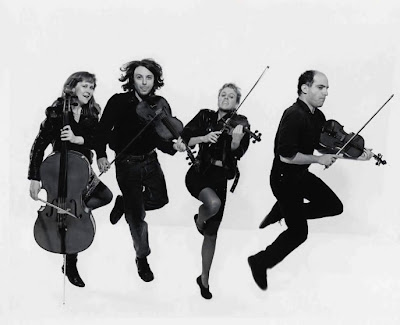
kidheadphones

When Glenn Gould wrote an interview with himself for High Fidelity magazine in 1974 (!), his imaginary interviewer (g.g.) asks him this question:

“g,g, … you’ve been quoted as saying that your involvement with recording—with media in general, indeed—represents an involvement with the future.

“G.G. That’s correct…”

“g.g. and you’ve also said that, conversely, the concert hall, the recital stage, the opera house, or whatever, represent the past—an aspect of your own past in particular, perhaps, as well as, in more general term’s, music’s past.”

G.G.That’s true…”

I hope that we in the West are breaking out of a confinement of music to the experts and the concert hall. I hope that we return it (or at least significant portions of it) to the messy context of the real lives of people. A lot of this has already happened since so many of us access most of the music we hear via recordings.

Small sees this coming. Indeed, he could conceive of his web of music as verb “as the most concrete and least mediated of artistic activities… brought into existence by all those who are taking part, even if the only person who appears to be taking part is a jogger with a Walkman or a solitary flute player in the African night.”

being married to a celebrity

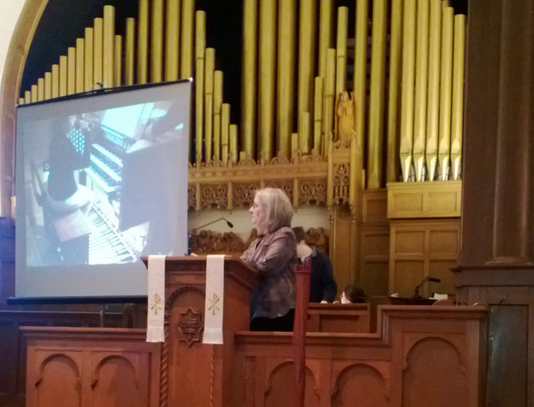
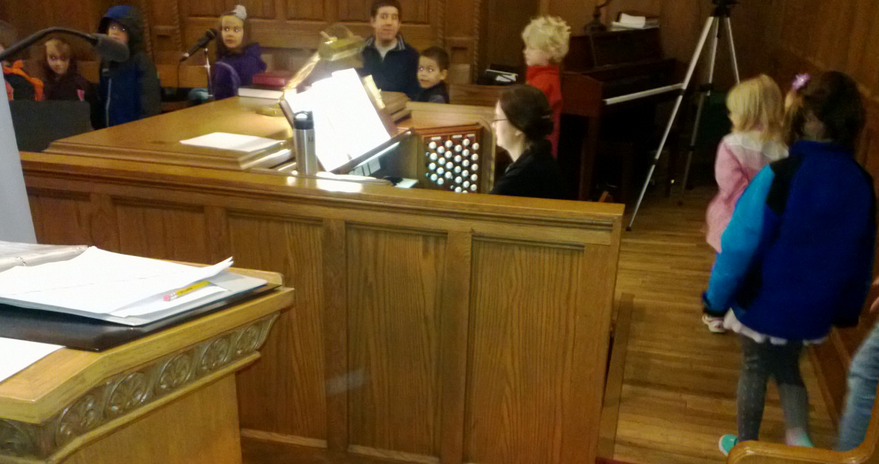
Eileen made her public debut this morning as narrator for “Peter and the Wolf.”

eileenpeterandthewolf01


She and Rhonda did it for a kindergarten class this morning.

eileenpeterandthewolf02

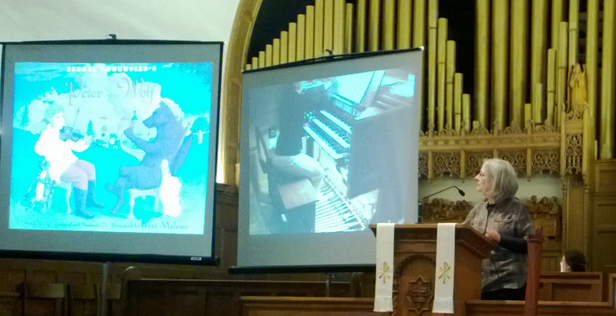
They flashed pictures from a book on one screen as Eileen read the narration and Rhonda played the piece on the organ.

Rhonda was visible at the organ on a second screen.

eileenpeterandthewolf03

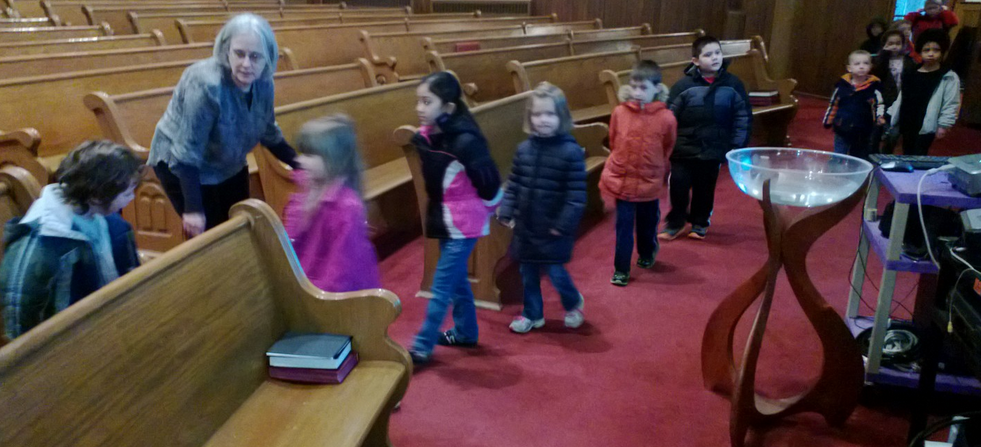
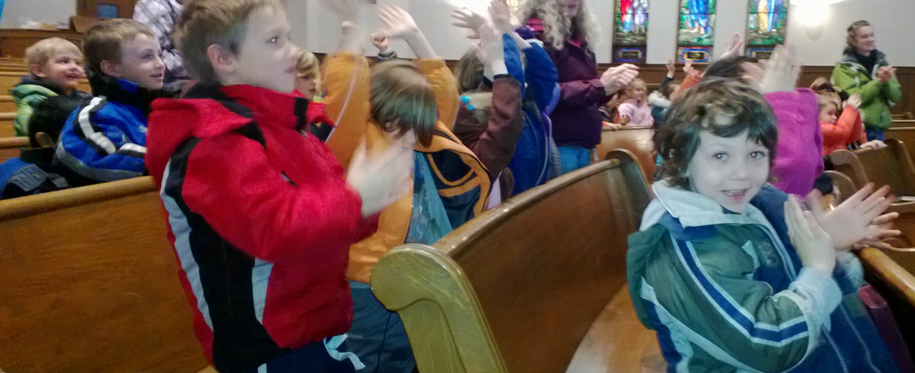
Beforehand they had the kids walk go up into the organ area and walk past as Rhonda played an exciting piece by Ian Farrington.

eileenpeterandthewolf04

The kids pretty much stayed with them. And seemed to like it quite a bit.

eileenpeterandthewolf05

Eileen and Rhonda are a good combination. Eileen is excellent at reading to kids. Rhonda is a virtuoso organist. It’s great being married to a celebrity and having a virtuoso for a colleague.

*****

Happiness, Beyond the Data – NYTimes.com

This is a blog for contemporary philosophy. According to Gary Gutting, the writer of this article four things are necessary for happiness: One must be free of suffering (have food, health a place to sleep), have fulfilling work, have pleasures including the pleasure of experiencing beauty, and most importantly have the happiness of human love. No wonder my life is so good.

*****

Israeli Court Rules for Women at Western Wall – NYTimes.com

Amazing. I didn’t think this would work out like this when they were arrested.

*****

Damaged by Hurricane Sandy, Verizon’s Jazz-Age Frescoes Glow Again – NYTimes.com

I put this link up on Facebook too. I think the Frescoes are very cool.

*****

Rand Paul Goes to Howard – NYTimes.com

Charles Blow lists off why Republicans have no purchase on African American voters. Good list.

*****

In China, Feudal Answers for Modern Problems – NYTimes.com

China turns back to some older useful Chinese concepts.

China Law Translate | Wen Zhou Official dies suddenly while under ‘double designation’

My son-in-law is involved with this site. Here’s a pretty amazing disturbing story. Disturbing for the content. Amazing that it was released.

*****

Dark Lightning Zaps Airline Passengers : Discovery News

*****


thanks very much and I hope we passed the audition


I had to play for a  ballet class yesterday where the teacher was being auditioned for a post in the dance department. At least that’s what they told me beforehand. When I arrived there was a woman I have been working with on Friday mornings all semester. I told her I had to play in her room this morning for an audition. She told me she was the person auditioning. Surprising.

Before too long we were immersed in a class and professors were lined  up in chairs taking notes. Unsurprisingly the teacher being auditioned remained calm and graceful under pressure. But it was evident she was under pressure. There was a palpable something in the air, as she taught. I think the students were rooting for her as was I.

This kind of pressure is not unusual in the professional arts. I think it can be brutal. I have seen it do damage to artistic people.

It seems very far from Christopher Small’s thinking about musicking for example. That art can be a verb and can be owned by everyone is something that gets lost when human beings start being kind of creepy to each other.

One of the reasons I like church music is that I am part of a large group of humans making art together. Part of the art is singing. Part of it is ritual. My personal faith is very weak to non existent having been beaten by a lifetime around Christians. Christians are just people and can be as bad or as good as anyone.

After the class one of the profs with whom I do not work regularly asked me about a certain piece of music I had played. I had to confess that I couldn’t call it back. I had just made it up in the moment. He was complimentary about it.

At Notre Dame I learned to at least behave with some kind of grace under pressure. The atmosphere there was also very brutal. Mostly in the profs not the students. Each week I would play for the Sunday service. Many of my professors were sitting below in the church. They judged harshly. Sometimes I would be performing their compositions. It was a tough gig.

At the end of my degree program I found out that most of the teachers thought I wouldn’t graduate, that I wasn’t good enough. This was not helpful to learn.

I did graduate and I did so with the usual academic accolades.

I also learned I think to look in other places for beauty and art.

Especially in the people I meet, no matter their station or supposed expertise or lack thereof.

*****

Hollande’s Camel, a Gift From Mali, Becomes Tagine – NYTimes.com

Mali gives the president of France a baby camel. He gave it to a local family. They ate it.

*****

How Exercise May Help Memory – NYTimes.com

Read this while treadmilling.

*****

Disturbing Pablo Neruda’s Rest – NYTimes.com

Some interesting facts about other people whose graves have been disturbed.

*****

Political Introspection – NYTimes.com

Conversation between David Brooks and Gail Collins.

good morning. and a book review


This day is getting off to a weird start. I got up and glanced out the window and didn’t see Eileen’s rent-a-car (her mini is being repaired). I actually went outside and walked around in case I was missing it in a morning stupor. No car.

Eileen had a late rehearsal last night and I was asleep by the time she was done.

I went upstairs and asked her where her car was. She had locked her keys in it at the church where her rehearsal was. Ah. Thank you to Rhonda for driving her home.

I came downstairs and tried to pick up the cat for his stupid morning hug. He scrambled out of my arms. Very unusual. Then I noticed urine all over the bathroom floor. Nice.

Good morning.

I finished Rachal Maddow’s Drift: The Unmooring of American Military Power. It’s impressive. As I was reading it and beginning to understand that Maddow has brains and insights, I tried to watch her  TV show. Yikes! I guess she has to act like that if she wants to be a TV personality. I couldn’t make it ten minutes into her shows. Too trivial and polemical.

The book however is not like that. It is chatty in an annoying TV way. But what it is saying is factually based and well researched.

Basically, she notes that we are addicted to war. She outlines the gradual expansion of the executive beginning with Lyndon Johnson. At the same time she shows how people in our government have  made legal what should be illegal (committing our country to armed conflict without public discussion much less approval among other things).

She ends with coherent concrete suggestions (that will of course be ignored).

It is a sad story of the “drift” of a good country into one unmoored.

Recommended.

*****

CourseSmart E-Textbooks Track Students’ Progress for Teachers – NYTimes.com

Just like your Kindle and other ebooks can remember where you are in the book, now your profs can see if you actually opened the dang online book.

Easy work arounds:  hire someone to flip through your etext and click the expected links.

*****

Chile Exhumes Pablo Neruda in Inquiry – NYTimes.com

Could this poet have been murdered? Stay tuned.

*****

How Raymond Davis Helped Turn Pakistan Against the United States – NYTimes.com

Oh my. People seem to think they live in a bad movie.

Only in reality, people actually get killed. Long sad story about more American incompetence.

*****

American Conservative Union Fighting Spending Cuts – NYTimes.com

That’s right. The ACU thinks we sh9uld NOT cut military and infrastructure.

See the Maddow book above.

*****


Reading the New York Times online


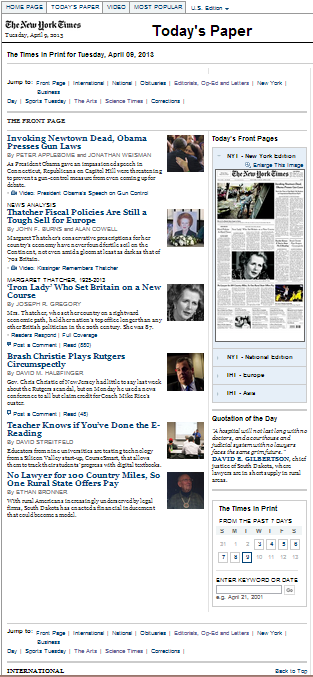
I’ve begun reading the New York Times online a bit differently. For several years I have started with the “Today’s Paper” section and simply read down the long page.

nyttodayspaper


This works out pretty well. There are little paragraphs under each link to an article which explain the article.

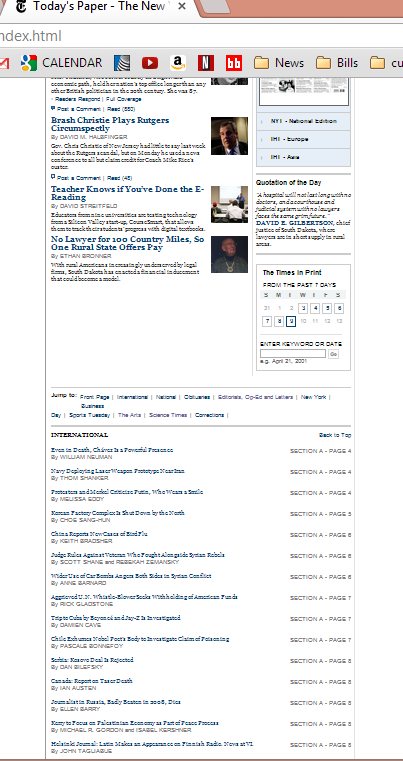
nyttodayspaper02


But after a few of those, there are simply the headlines and the writer. Often these headlines (in the way of old newspaper writing) are enigmatic. They try to be catchy. Originally they would be right above the prose, so one could quickly scan from the headline to the first paragraph and figure out what the article was about.

Now when I use the “Today’s Paper” portal, I will click and read enough to find out if it’s something I want to read. Often it isn’t.

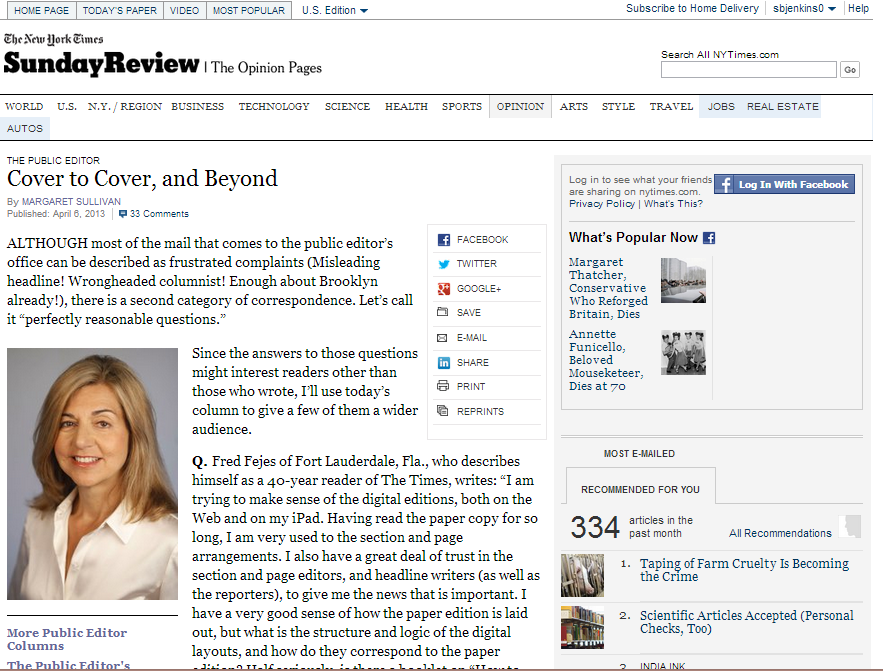
covertocover


On Sunday, Margaret Sullivan, the “public editor” or ombudsman of the New York Times answered reader questions about how to read the New York Times online or on their device.

I learned that the designers recommend beginning not with the “Today’s Paper Section” but the Homepage.

nythomepage

I have been reading the New York Times online for several years. I consciously moved away from the paper edition gradually. I had a disagreement with a local librarian that the New York Times was a basic feature of any real library. She refused to put it on her shelves. But she accepted my donation. So for a year or so, in an experiment, I donated the paper edition to the library and read it online. I did this also because at that time there was no provision for just having an online subscription. It was only an added feature to having a paper subscription.

But before too long, the NYT got hip and allowed one to subscribe just online. So I ended up doing that. I still do this.

After reading Sunday’s article by Margaret Sullivan (with information both from users and designers of the online edition), I thought I would give the Home Page another try.

And I’m finding it superior. Most of the articles on it and the subsequent section portals it leads to (International, World, Technology, etc.) have a synopsis of the content under the headline. Very helpful.

In addition instead of a list of the articles in print, it prioritizes articles and online only content much more coherently.

Cool.

*****

‘Nuntii Latini,’ News Broadcast in Finland, Unites Fans of Latin – NYTimes.com

Broadcasting in classical Latin. Makes me wish I was fluent in Latin.

*****

Les Blank, Documentary Filmmaker, Dies at 77 – NYTimes.com

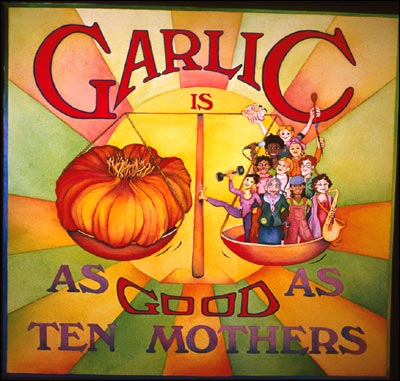
This guy made the very cool films, “Gap Toothed Women,” and “Garlic is as Good as Ten Mothers.”

*****

Targeted Killing Comes to Define War on Terror – NYTimes.com

“Since Mr. Obama took office, the C.I.A. and military have killed about 3,000 people in counterterrorist strikes in Pakistan, Yemen and Somalia, mostly using drones.”

*****

Closing the Door on Hackers – NYTimes.com

“Too much of the debate begins and ends with the perpetrators and the victims of cyberattacks, and not enough is focused on the real problem: the insecure software or technology that allows such attacks to succeed. Instead of focusing solely on employees who accidentally open e-mails, we should also be pressuring software makers to make significant investments in their products’ security.”

*****

Anxiety and Avoidance – NYTimes.com

Some common sense and some brain science.

*****

Hugh McCracken, a Studio Musician in High Demand, Dies at 70 – NYTimes.com

Paul McCartney asked McCracken to be in the original group, Wings. He declined. He’s survived by his mother as well as the rest of  his extended family. His mother!

****

no time for pics today, barely time to blog


It’s almost 4 PM here in Holland Michigan. I usually write in the morning, but my brother and my sister-in-law were visiting so I skipped it this morning.

I am beginning to think I have a bit of my groove back after Easter and Hope College exhaustion. My class was thankfully canceled this morning. Eileen broke the upstairs bathroom sink drain last night (she was trying to fix it). So Mark, Leigh and I waited for the plumber while she went off and practiced “Peter and the Wolfe.” This is a bit of role reversal. Her leaving to do music. But I quite like it.

Sunday night Leigh, Mark, Eileen and I had a nice meal out together at the CityVu Bistro.

Today Mark convinced Mom to get out of her room and have lunch with us. She was in the mood for a burger and wanted to pick up some food from Wendys and go to our house and eat it. So that’s what we did. Eileen had to be at work around noon so she couldn’t join us for this.

In a few minutes I will make Eileen and me sandwiches and take food over for her lunch break.

It’s been a very relaxing day for me.

******

Margaret Thatcher, Conservative Who Reforged Britain, Dies – NYTimes.com

This obit in today’s NYT is one of the reasons I like reading the NYT. It provides a thorough over view of Thatcher’s life in politics and government. Helpful to review even though I was aware of her throughout most of her public life.

*****

A Passion for Reading – NYTimes.com

The Real Deal – NYTimes.com

These are a couple of letters to the editors link. In the first one the letter writer says what I often think —- that we are risking the loss of passion for learning as an end in and of itself. In the second link, Deborah Tannen writes to the NYT and has some salient insights (I admire her and have read books by her).

*****

Q. and A.: Tracy Thompson on ‘The New Mind of the South’ – NYTimes.com

Having lived in the South I found this interview fascinating.

*****

Can We Get Hillary Without the Foolery? – NYTimes.com

I read Maureen Dowd but don’t often link her in. This is one of her better efforts.

******

Edith Schaeffer, 98, Dies – Defined Christian Values – NYTimes.com

I am reading a book by the son of this woman so I was surprised to see her obit.

*****

harmony, heavenly harmony


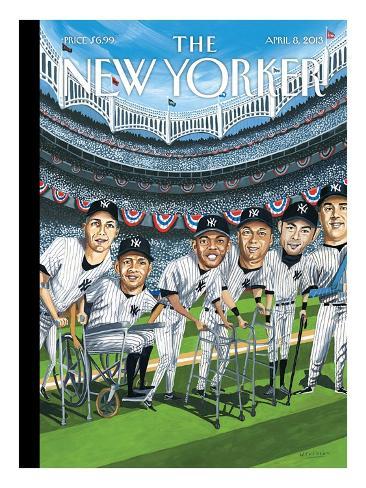
Jermey Denk the concert pianist has a lovely article in the April 8th edition of the New Yorker. I would link it in but it’s locked away in their subscriber only section (stupid stupid stupid).

It’s called “Every Good Boy Does Fine.” You might recognize from where he took his title.

It begins with his parents bringing him a little black notebook he kept as a piano student. It is filled with comments and memories about his study with William Leland, a teacher who seems to have taught him well early in his career.

The book is a record apparently quite extensive of his study with Leland. Leland sounds like a character. He improvises the prized “stars” piano students often receive by hand: “… sometimes the stars were beaming with pride, sporting halos or crowns; sometimes they had sidelong glances, to reflected mitigated success; some stars were amputees, and limped on crutches…” Leland not only writes his own comments (“Practicing a passage is not just repetition but really concentrating and burning every detail into your nervous system.”) but also jots down memorable words from his young student: “Quote of the Week” — “It’s amazing what you can do when you go slower.” The words in the book ring so strongly in Denk’s memory that he writes “It took me weeks to silence the voice [in the book] and play normally again.”

Denk’s charming and informative article moves quickly to his undergraduate experience at Oberlin where he eventually is exposed to György Sebők a prof visiting from Indiana U. This begins a huge influence on Denk’s life which he writes about eloquently.

The part that sticks in my mind is Denk’s description of Sebők’s unusual habit of sketching out harmony on a second piano while a student performed for the class. He adds “chords quietly from time to time, to enunciate a higher rhythm of events…. It was unforgettable, this demonstration of poetry of structure… ” Denk comments that later he would be listening to performances and wish “that Sebők would come onstage and start playing those chords, so that the performers would stop producing sausage-string phrases and give us ones that know their surrounds.”

This morning I continued reading in Christopher Small’s Musicking. I am beginning to understand Small as speaking from a conservative point of view, more accurately working toward breaking free of a conservative conventional point of view, that I as a musician have never really shared or bought into.

His treatment of harmony reveals both his insights and limitations.

He quotes Dryden:

“From harmony, heavenly harmony,
The universal frame began,”

as evidence of the “controlling power of the chordal progressions of tonal harmony.” I believe he is under the academic mis-perception that harmony is the main way musical tension and resolution is created. There is so much more to it than this and I’m sure Small perceived this. But his argument reduces music to types that “delay gratification” by using harmony to create “variation,” “surprises,” and “forward motion.” By this I think he means a lot of classical music that symphony orchestras play. But music that uses simpler more predictable chords (He mentions blues and jazz) arouse only the security of predictability and and with this predictability renounce variation, surprise, forward motion, etc.

I disagree with this notion. One only has to think of the wonderful performances of blues musicians and jazz musicians one loves to know that their artistic statement is complete even under this kind of scrutiny.

Small himself goes on to say that the classical composers who supposedly renounce 19th century harmony manage to create music which is varied, surprises, moves forward, climaxes, creates resolution, but through means other than harmonic ones.

This makes his observations seem a bit one dimensional to me. But I guess they make sense if you have been educated solely in the classical tradition (as Small was I’m pretty sure) and are trying to break free of these blinders.

******

UN Passes Historic Arms Trade Treaty To Media Silence | Blog | Media Matters for America

This article points out the dearth of media coverage on this. NYT seems to be the only major source that covered it.

*****

‘Otherwise – Queer Scholarship Into Song,’ at Dixon Place – NYTimes.com

Charming article about doing academic research reporting to the tune of “Girl from Ipanema.” Recommended. Made me smile more than once.

*****

A New Era in Political Corruption – NYTimes.com

“We have a system that only catches morons,” sighed a member of the State Legislature

*****

Hunger Strike at Guantánamo Bay – NYTimes.com

“a collective act of despair”

*****
In Many Capital Cases, Less Culpable Defendants Receive Death Penalty – NYTimes.com

“It’s a total mystery who is going to face the death penalty and who is not.”

*****


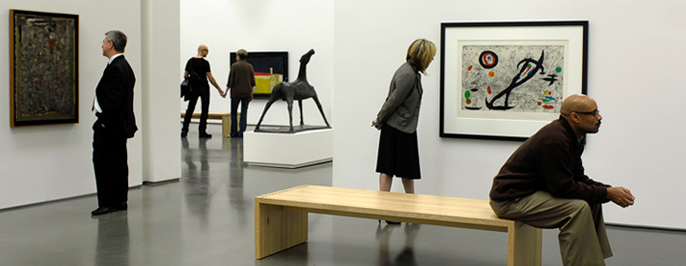
“Here in the museum we do not invite trouble”

The title of today’s post is the first line in John Ashbery’s poem, “Quick Question.”

museum

Quick Question is also the title of the book of poetry in which it is found. It reminds me of how I think about music performance and universities.  I believe it might be changing slightly, mostly in the students. But the odd way in which musicians (professors) focus on their careers, the parameters of their daily lives and not music itself echoes the idea that a museum is more sterile than what spawned the marvelous creations it houses.

Another quote pops to mind from this morning’s reading:

“I could beginne againe to court and praise,
And in that pleasure lengthen the short dayes
Of my lifes lease; like Painters that do take
Delight, not in made worke, but whiles they make;”

John Donne, “Elegie: The Expostulation

Music and probably all art is about the doing of it, the action of it. Scaffolds of pretentious clutter that hide the beauty and fun notwithstanding, for me, music is a door to meaning which opens up a meaningful life. It is a holy ritual.

“Ritual, of course, is action; it is something that people do. Its meaning lies not in the created objects that are worn, or exhibited, or eaten, or performed, or otherwise used, but in the acts of creating, wearing, exhibiing, eating, performing, and using.” Christopher Small, Musicking p. 107 or location 2363 Kindle book.

Christopher Small understands this.

“Properly understood, then, all art is performance art, which is to say that it is first and foremost activity.” Christopher Small, Musicking p. 108 or location 2392 Kindle book.


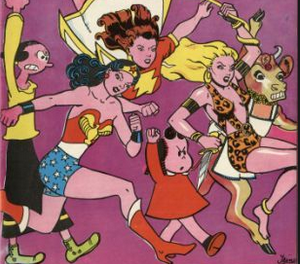
performanceart

He also tends to think of musical performances in terms of social relationships. This is especially significant when thinking about music that is improvised by individuals or groups.

As I think about this I wonder about the significance of the shifting ways humans are experiencing music via recordings. It boggles my little pea brain. I await my books by and about Glenn Gould to continue thinking about this.

Image

In the meantime, I want to mention that I have had many nice compliments from learned musicians lately. I was accosted at New Holland Brewery by a parishioner who is a musician. He thanked me for playing the Widor Toccata. I thanked him for listening to it. There’s a social relationship, eh?

A woman leaned across the table and said that she wanted to make sure that she took this opportunity to say how well I had played the Widor on Easter Sunday morning. She also is a degreed musician.

Since most local music profs keep their distance from me, it is nice to have some non-professors who are also trained musicians notice my work.

I write about it here to balance my usual bitching and self pity.

selfworship

*****

A Brief History of Applause, the ‘Big Data’ of the Ancient World – Megan Garber – The Atlantic

Just what it says. Emphasis on ancient Rome.

*****

After God: What can atheists learn from believers?

bookmarked to read as are the rest of the links below

*****

madness and civilization – bookforum.com / current issue

Cabinet is a magazine I have never heard of. This is a description of it and a recent mock trial of it.

*****

The bitter fool by David Yezzi – The New Criterion

Satire replacing the absence of poetic impulse?

*****

The lips, the teeth, the tip of the tongue by Denis Donoghue – The New Criterion

Another poetry link. I had to bookmark it because it echoes a diction exercise I have long used with children’s choirs: “Lips, teeth, tip of the tongue; lips teeth tip of the tongue; lipsteethtipofthetongue.”

*****