Monthly Archives: June 2009

compliments and fatigue

I’m hoping for a bit of a day off today. I don’t really feel like I have completely recovered from our England trip. I was just getting over the jet lag when I came down with the achey shakey flu. Then Eileen’s Dad died. Yesterday we drove to Chicago and deposited my lovely daughter, Sarah, at O’Hare.

So it looks like today nothing is really planned. I’ll need to check on my Mom at the hospital but that’s really my only task.

Yesterday I did the service entirely without the organ. Afterwards I once again had several unsoliticited compliments.

Two from visitors. One guy liked the way I do “Here I am.” Actually as I was doing it it crossed my mind how the GIA executive editor once wrote me in a letter how I do this style of music (Catholic folk stuff) wrong. I “overplay” it. Indeed this visitor said he thought I did it more like a march. I told him that I tried to design an accompaniment for congregational singing. Also that I have done a brass arrangement which was indeed like the “trio” of a march.
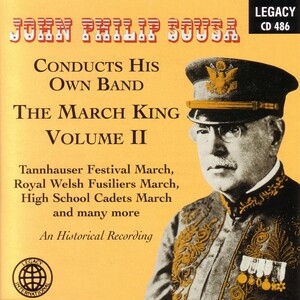
The other visitor said he was a life long Episcopalian who hadn’t been to church  in a while. He said that the music was more like a “broadway” musical and that he liked it.

I pointed out that usually I mix up using the organ and the piano but that the organ was out of commission.

The former organist said that she enjoyed my Scarlatti. I played one of his sonatas and decided as I was performing it do the repeats. I guess this was a mistake because when I neared the end of the second section for the second time, someone moving near the piano distracted me and I struck a wrong chord. Damn! Oh well.

Another parishioner said she liked the recorder. I did the closing hymn with guitars and recorder. It was the German chorale, Allein Gott. Even though this tune is actually based on a tenth century Gregorian chant, I made it sound like a medieval dance with a drone on one guitar and having the other guitar double the melody with the soprano recorder.

I find it interesting that I am feeling so burned out about the choir program at my church and that I do receive weekly compliments that make me blush. I suppose the people who hate what I am doing don’t talk to me about it.  From listening to the chairperson of the Worship Commission a few months ago, there are definitely people in the congregation who find me difficult to take.

But of course that’s true of many people in this provincial religioius town.

Anyway, I keep thinking about doing some composing. I have been invited to a composer get together this Friday in Grand Rapids. The guy convening the discussion is my friend, Nick Palmer, who is currently the Roman Catholic Cathedral guy. I really like him and he is a top notch composer. So I’m glad that he keeps including me even though I’m not sure how hot I am to trot about writing church music right now.

But it would be good discipline to do something. I was even (Godhelpme) thinking of writing a fugue this morning for practice. My counterpoint teacher said some discouraging things to me about my ability to write a fugue in the style of Bach. It’s so easy to remember the negative things people say to you, I guess.  On the other hand, the same dude offered me a teaching assistantship in theory at Southern Methodone University where he was going to head up the theory department so he must have thought I had some skills.

I haven’t done the treadmill yet this morning. Waiting for my beautiful wife to leave for a doctor’s appointment first.

poetry corner

As I was on my treadmill this morning, I was reading The Gift:Creativity and the Artist in the Modern World  by Lewis Hyde. I recently ordered my own copy of this book after reading the library’s copy for a while. re-reading the first chapter, I had a bit of an insight involving an old poem of mine.

Hyde talks about a “widening” of the ego. From self, to relationship, to larger community. 

If the ego widens … it really does change its nature and become something we would no longer call ego. There is a consciousness in which we act as part of things larger even than the race. When I picture this, I always think of the end of “Song of Myself” where Whitman dissolves into the air”

Whitman writes;

I effuse my flesh in eddies, and drift in lacy jags.

I bequeath myself to the dirt to grow from the grass I love,
If you want me again look for me under your boot soles.

When I was younger I overheard a friend of mine muse that if I kept writing poetry it had to get better. This left me wondering how bad my poetry was. Little did I know that this was a feeling I would re-visit throughout my life. I like my music and poetry and think it’s worthwhile. But at the same time, I am willing to grant my own subjectiveness and bias. I think of the great flutist, Jean PIerre Rampal, lingering in the wings of a church where applause was forbidden. When he was asked to play an encore, he wryly refused saying, maybe they didn’t like it. 

Once I showed a poem to a composer/professor I knew. This professor and I had a weird relationship. I think in retrospect I may have intimidated him. At the time, I felt he had all the cards of life: composing, a teaching job, skills. He agreed to teach me the (now defunct) art of music calligraphy but stipulated that he would not take me as a composition student. 

When I showed him the poem, I remember the look on his face or at least my impression of his reaction. He seemed to see in my poem a revealing of my own little egotistic needs. Here’s the poem:

SOUND LONGING

                         When I was
A child I wanted to be a river
Calm as a falling pebble.
On my shores trees turn in
Simple wavering dance,
Hesitating in the palm
of a river child.
                            Unsatisfied
I asked dripping lovers to be
Liquid. O the many and same
Asked into my head until
Light went dead within
Tremorous calm.
                        Now balanced
On the skin of my lover I am
Lost in danger of simple desire:

I want to be a tremor of the air
Inside greed ears of trees.
I want to be an instant on the arms
Of all, sound in the sky that
Comes and goes like a single breath.
Old river longing grown into
A hopeless scheme drawn from
The still night, neither expected nor
Doubted.
Feb 1974

I like to think I was trying to capture more what Hyde and Whitman had in mind than my composer prof. 

entry from the ER


Yesterday was the memorial service for my wife’s father, Clyde. Whew. Everything went fine, but I am tiring of these sorts of events.

It is nice to see everyone. And I am enjoying having my lovely daughters around. In fact we four (Eileen, Elizabeth, Sarah and me) had a very nice little supper together last night. 

I am writing this entry from the Emergency Room of Holland Hospital. Earlier today I received a phone call from the place where my Mom lives saying that the nurse felt she (my Mom) should be taken to the ER for evaluation due to symptoms she has been complaining of.

Sure enough, Mom has pneumonia and is being admitted for a two day stay. She is fatigued and having trouble breathing. They have already given her two kinds of antibiotics. I think she is pretty comfortable for someone suffering from pneumonia.

In the meantime, I have been sitting here working on paperwork for the internimable application to medicaid on behalf of my Mom (and deceased Father). I also did a bit of Greek. And uploaded photos from yesterday to Facebook. 

human emotion

“Nothing in this world is permanent, and we’re foolish when we ask anything to last, but surely we’re still more foolish not to take delight in it while we have it. If change is of the essence of existence one would have thought it only sensible to make it the premise of our philosophy. We can none of us step into the same river twice, but the river flows on and the other river we step into is cool and refreshing too.

from The Razor’s Edge by Somerset Maugham

I have been neglecting my blog, but not by design.  The last couple of mornings, by the time I get my coffee and treadmill time in, I have to immediately start doing other things.

Tuesday, after exercising, I continued transcribing Vaughn Williams’s “Six Studies in English Folk Song for Cello and Piano” for saxophone. By the time my friend Jordan arrived, I had four of them done. He and I managed to find about fifty minutes to practice. He had decided to bring his soprano sax and we read through Astor PIazolla’s “Histoire du Tango.” It was fun. I still have two “Studies” to finish transcribing and we’ll get to them sometime, I’m sure. 

The quote at the beginng is from a book I read on vacation. Or I should say re-read. I love Maugham, especially in the first person. I have several passages underlined from this last reading. The one at the beginning of this entry is one that is meaningful to me. I feel more and more that life is to be savored and enjoyed even as it ebbs. 

By this I mean immersing one’s self in the stuff of life which for me is loving those I love and making music and readinging and listening and eating good food and whatever…..

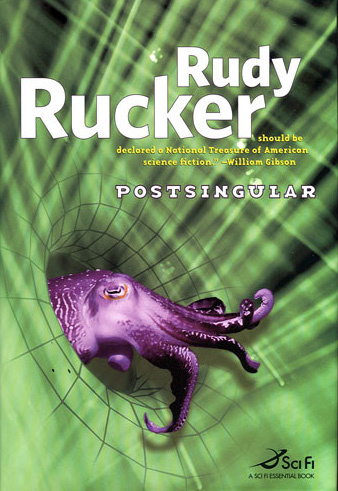
Rudy Rucker was recently a guest blogger on one of my favorite web sites: Boing Boing. He mentioned his recent publication of a sci fi novel and it turns out he has written many of them. I discovered the local library owns several of  his books and checked out “Postsingular” by him.  Very cool. Here’s what he says about the plot:

Postsingular takes on the question of what will happen after the Singularity—what will happen after computers become as smart as humans and nanotechnology takes on the power of magic?…


a congenial breed of quantum-computing nanomachines called orphids [is developed by characters in the book].

The orphids coat the planet, one or two per square millimeter, and now everyone is on-line all the time, and everything is visible in the orphidnet. Artificial life forms emerge in the orphidnet, and they pyramid together into a superhuman planetary mind. People can mentally access this mind and feel like geniuses—with the catch that when they come down they can’t really remember what they saw. And this new kind of high is addictive.


It reminded me of a recent comment made to me by an elderly gentlemen when I expressed puzzlement about his not being able to find some information readily available on the web: “I am not addicted to the web.”

Hmmmm. I think maybe I am.

Anyway, I am enjoying this book. It is the first of two books on this story and I look forward to reading them both.

Monday I went to practice organ and was unable to get the instrument to even turn on. It was some time before I realized that the organ was scheduled to be releathered at the first of June. Oh yeah. Now I remember.

This necessitated changing my organ prelude and postlude to piano pieces.

No problem there. I simply scheduled a Domenico Scarlatti sonata that has recently caught my fancy (Sonata in B minor, K87) and then took advantage of this opportunity and scheduled “La Trece” by Renee Touzet.

Touzet is a Cuban American composer who caught my fancy a few years ago when I read about him in a piano magazine. He wrote a great number of piano pieces based on Cuban dance rhythms and (bonus) caught the eye of Ricky (BabaLOO) Ricardo who made him his piano player.

I had fun running his music down which seemed to be mostly available at a music store in Miami he used to frequent when he was alive. 

I like the music quite abit and I especially like the one I have scheduled for Sunday’s postlude. 

While I was practicing it, my wife (and important critic) wandered in and said, “This is a one of the good ones.” True.

Speaking of trade mags, last night I read a delightful letter in the June issue of the AGO (American Guild of Organists) Journal. Recently there have been a series of letters in the magazine deploring the dissonant music that so many musicians (organists especially of course) schedule for public performance. I had barely realized I was following this discussion from month to month. It sounded like the background noise of my own arguments with people in my head.

I think this discussion had so influenced my own prejudices to the point that I was genuinely surprised when my old organ teacher (whom Eileen and I ran into at the International Airport in Detroit) not only thought that Messiaen’s Pentecost Mass for Organ was his masterpiece (presumably for organ) but sang the cool Lark theme of it to me. For some reason I expected him to lean away from Messiaen and more toward the tonal. 

Also locally I seem to be unable to connect well with other organists and college types. 

All this contributes to my own assumption that my tastes are not the tastes of many if not most people who are as trained as I am or even better trained. 

Anyway this letter seems to be from a high school student respectively disagreeing with his conservative elders. And lo and behold he mentioned Messiaen several times as an example of music “quite accessible to human emotion.” Be still my heart. Cool beans.

Also in this issue, I found out that Schirmer apparently allows people to access their catalogue via free subscription including downloading copies of music for examination. I haven’t tried yet. It probably has a catch like proving your not some schmuck like me unaffiliated with a college or publishing house. But still it’s worth a  try. Schirmer on Demand.

post church report

I continue to be baffled at the popularity of shows like “American Idol.” I have friends and family who regularly watch and enjoy this show in particular. The phoniness and the cruelty seems not to register to them. Maybe I’m overly sensitive and speaking from a point of view that is suspicious of the U.S. culture of celebrity.

Recently visiting the U.K. I suspected that in England there seems to be something in addition to the pervasive culture of celebrity and consuming. In the United States, not so much. 

Yesterday I read a quote “This American Idol” in the NYT that seemed true:

“This show is all about manipulating the eagerness for celebrity among vulnerable, often desperate people,” David Wilson, a professor at Birmingham City University who briefly worked as a psychologist on “Big Brother” several years ago, wrote in The Daily Mail. “The more tears, humiliation, conflict and embarrassment, the more the public loves it.” link to NYT article

It’s interesting that this is on my mind because I have to report that yesterday’s Pentecost service seems to have gone very well despite my ongoing personal lack of balance and perspective. 

I pretty much killed the prelude which was an easy little piece based on the opening hymn.

Eileen said she didn’t notice which only makes me think it wasn’t too obvious, but still I thought to myself, “This is an inauspicious beginning to a tough service.”

The first cool moment came when I dropped out of the 3rd and 4th stanza of the sequence hymn, “Breathe on me Breath of God.” The congregation (albeit with the choir’s strong support) continued to sing lustily in four parts without the organ. Very nice.

For traveling music after the gospel, I played a section of my postlude on flutes. I thought that since Messiaen was thinking of Pentecost and wind anyway, that I would use his notes and do them on a flute stop. I definitely liked the way it sounded at that point in the service. 

The anthem organ accompaniment was a bit challenging. Although it was a relief to just have to play the organ and watch the guest conductor, the writing and page turns kept me on my toes. The conductor did a great job and I thought the anthem came off well providing a nice artistic pictorial piece that described the Pentecost story. 

I did the two communion hymns and the closing hymn at the piano. At the end of communion I improvised quite a bit using motives from the folky second hymn. The closing hymn was “There’s a sweet sweet spirit” and I played sort of a gospel style piano accompaniment to it. 

Then I lept up and ran to the organ and played the Messiaen piece I have been working on for weeks. I made a false start by neglecting to put the crescendo pedal on as I had previously planned. When I realized my mistake I chose a spot and simply started over. No harm done.

After the service I had many comments. Several people listened closely to the postlude. One woman who is a professional musician said several paragraphs of compliments about my improvisations. Another young mother said that she was sorry she couldn’t “cheer” after my communion improvs. I’m serious. That’s what she said. 

It does gratify (if not embarrass) me to receive such laudatory comments.

Which brings me back around I guess to our culture of celebrity here in the U.S.

I enjoy the community I work for. I enjoy doing a job well and that people seem to notice. But I’m uncomfortable with the idea that my music is mostly about me and not something bigger. I guess the compliments do not mean that listeners aren’t focused on the music as they experience it. Hopefully they are. But in this climate of emphasis on the “magic” of the performer, I do hope that this is the primary connection and that they then feel a need to express their approbation to me so that I know they did hear the music. 

I have come to the conclusion that one of the things I do enjoy about church work is that the most important music is the music the entire community makes together: the hymns, the canticles… I know that making music is a basic intrinsic thing to the enjoyment and fulfilment of living. To relegate it soley to the specialist is a mistake and diminishes its importance as far as I’m concerned.  Certainly we need the cosmic reach of the great minds in art. But at the same time I think we also need each and every artistic voice that is inside of each of us no matter how clumsy or inept. 

In fact it is often the unrefined that attracts me. 

Anyway, end of sermon.