Monthly Archives: January 2011

to sync or not to sync

So Google Chrome Browser has a feature which will sync your bookmarks from one computer to another.

Unfortunately I have developed two sets of bookmarks for my two computers. Yesterday I spent hours trying to set up the bookmarks on my desktop browser so that I could sync them to my netbook. I felt like my brains were leaking out after about three hours.

I guess it was a good way to spend some time off.

I hit a glitch with the super secret Hope college web site for accessing their wireless on campus.

I couldn’t get the web site url to work properly in a copied bookmark. Sigh. It was right about at this time I decided that maybe I wouldn’t sync the two computers.

I also gave in and downloaded Juice, a free software that will subscribe to podcasts. I have resisted this so far.  Itunes is dominant in this area and I do not do Itunes. Every once in a while I will attempt to install it but fail.  So I used Juice to subscribe to several podcasts (This American Life, On the Media and several other NPR podcasts).

The New York Times seems to only allow Itunes as a subscription service to its podcasts.

It’s just as well since the NYT podcast page is bewilderingly disorganized presenting a list of podcasts that are organized not by date (!), but by some other mystifying way.

I just figured it out! I thought I would go over to the NYT podcast page and try to understand that organization so I could bitch about it.  It’s organized alphabetically, not by time, in this order:  Backstory, Bookreview, Front Page, Music Popcast, NYT Tech Talk, Science Times, The Caucus, The Ethicist, Times Talk, Weekend Business.  These are all idiosyncratic NYT’s podcast titles. Note the alphabetizing of titles under “The.”  Sigh. Some of these podcasts change weekly, some “occasionally.” I think this is haphazard and have mentioned it in emails to the NYT.

It amazes me that the old grey lady (the New York Times) is so backward in its tech.

If you click on a share on Facebook button on one of their articles, it pops you into a request to access all of your Facebook info and permission to email you about stuff. I don’t do this. I simple copy the url of the article when I share it.

The idea of “syncing” has never appealed that much to me.

Windows Media 11 is obnoxious about how it wants to sync stuff with my MP3 player. It only syncs playlists. Very helpful (sarcasm). And my MP3 player has no other way to make a playlist expect by downloading the entire list from Windows Media. No way to organize files into a play list on the player.

These methods of thinking designed into these tech things seem cumbersome to me, designed for ease of use by users who don’t quite get what they are doing.

I suppose this is just my age showing.

Thinking of MP3s and Podcasts as files.

Anyway, I have given up in both cases and do things the way they are designed.

But I still haven’t installed Itunes. Heh.

another good day for jupe

Music went well yesterday at church. I had a very small group of singers for the service: 1 sop, 3 altos, 2 tenors. The anthem I had chosen, a setting of the famous text, “At The Name of Jesus,” to the French carol tune, Noel Nouvelet,  worked well.  In the pregame, I took the choir through sequence hymn, “I come, the great Redeemer cries,” set to the lovely tune, This Endris Night, harmonized by Vaughan Williams. Afterwards I said now at least 6 people will know the tune the prelude is based on.

The prelude, a setting by George Oldroyd, went very well. I was very proud of the way I was able to execute the registration changes and create a smooth slow crescendo with this lovely, little modest English pastorale setting of “This Endris Night.”

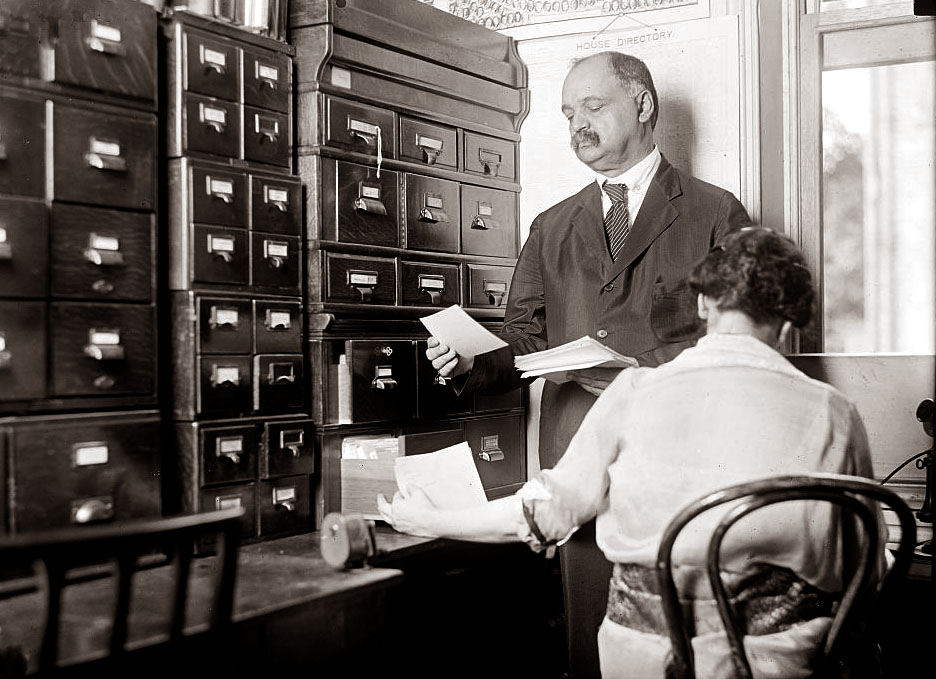
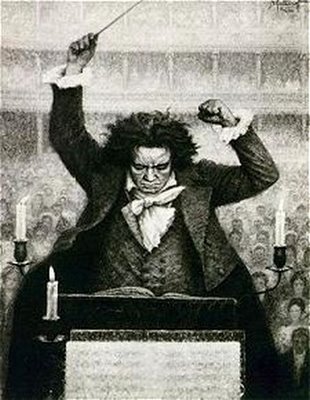
This photograph is neither Oldroyd, or myself. I just like the guy's attitude and attire.

The communion hymns were a praise chorus, “Jesus, name above all names,” and a neat little rendition of the African American Spiritual, “Take me to the water.”  These were fun. I also asked my one soprano to sing descants on the opening hymn, “Songs of Thankfulness and Praise,” the sequence hymn mentioned above and the closing hymn, “O Love, how deep, how broad, how high,” sung to the tune DEUS TUORUM MILITUM.  This was also kind of fun. The postlude also went well.

My boss was out of town. Attendance was down.

People seemed a bit disconnected from the prayer, but we did our damnedest and I thought it was pretty good. A couple of visiting musicians from Muskegon were cool to me afterwards, but that’s not that unusual. We often have musicians visiting and they sometimes don’t know what to make of the fuzzy old man in the back getting the music going.  Fuck the duck.

While I’m being all religious and shit, I might as well share the silly Music Notes  (Of which I am also pretty proud) I put in the bulletin yesterday:

Music Notes The story of the Baptism of Christ is a quintessential Epiphany story. Epiphany is defined accurately by Wikipedia as “… the sudden realization or comprehension of the (larger) essence or meaning of something. …(from the ancient Greek , epiphaneia, “manifestation, striking appearance”)” In the readings assigned to Lectionary Year A, there is an emphasis on Christ, himself, as servant and the one who comes to fulfill the prophecy. Thus today’s hymns center on Jesus and Baptism. From today’s opening hymn,  “Songs of Thankfulness and praise,” to the closing, “O love, how deep, how broad, how high,” we give voice to words of manifestation of God in human form and the deep love of God that is revealed in Christ’s appearance in history. Our first communion hymn is one of the best known of praise choruses, “Jesus, name above all names.” Its centering on the name of Jesus reminds us of how God calls Jesus by name from the cloud in today’s gospel and how important this event was. It is taken from Voices Found. “Take me to the Water,” an African-American Spiritual taken from Lift Every Voice and Sing II, reminds us of Jesus’s insistence on being baptized by John.  “There was a time in south,” Gwendolin Sims Warren writes, “in the early days of slavery under the British law, when English planters thought baptism… made it necessary to free a slave—and so they forbade the ritual.” The radical nature of a slave singing this song in that situation emphasizes the liberation Christ brings to all in baptism. Today’s prelude is based on the sequence hymn, “I come,” the great Redeemer cries and the postlude is based on the melody from today’s Choral anthem, “At the Name of Jesus.” submitted by Steve Jenkins, Music Director

You can see I put a lot of effort into this stuff. But what the heck, I like doing it.

Came home and made Mexican Macaroni and Cheese for Eileen and me to eat. Studied what Charles Rosen has to say about the Haydn Piano trios I have recently taken an interest in (a lot!).

Another good day for Jupe.

human relationships and the internet

[Warning: another long self obsessed blog post from jupe with 2 many dang wirds]
Lately I’ve been pondering my own ideas about how human relationships work. I think they are based on blood ties,  common interests, and/or history.  I know I have some pretty strong convictions about how I think relationships work. These convictions say a lot about who I have been and who I am now and at best are but a body part of the elephant in the room: the complexity of human interaction.

I think relationships work best with good feedback. I think this feedback is most effective in person and live. When I am talking to someone, I am very aware of the entire person, not just the words they are saying (or not saying). This kind of interaction is so intuitive it defies my own attempts at analyzing. But nevertheless I do think about this and also realize that my perception of who other people are include presence and history in a very deep way.

This presence (and often the history) can be lost in communication without emotion such as email or exchanges on the internet.  Writing email or communicating on the internet is so tricky these days because it often involves quick casual comments. These comments are framed by our emotion of the moment. These are so obvious to us, we often don’t realize how important they are to what we are saying.  What we mean would be much more obvious to the person we are addressing if they were in the same room with smelling us and tasting our moods and multiple quick reactions.

This extra information is often pointed to as the most of our communication to each other, much more than the words of our spoken or written language. That’s why written language continues to be such an art.

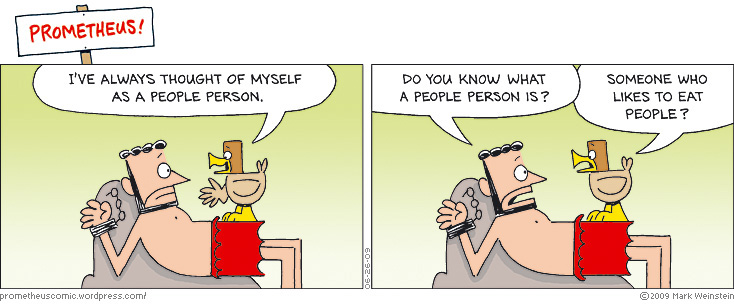
Good web designers of many ilks often say to themselves and others, when you communicate on the web: Talk like a person!

I take this to mean that if we avoid the false objectivity of academic parrot talk and lapse into our normal everyday speech we are much more likely to be understood.

Of course good writing for me involves clarity and simplicity.

This brings me to my next  idea about relationships and communication.  Even the meanings of words themselves change over time. And we as people constantly evolve and change sometimes into very different people from whom we have been. I think of my own father in the throes of his devolving personality due to the illness that killed him (Lewy Body Dementia).

I now believe that the normal metamorphosis of personality that inevitably occurs in each of us was sped up in my Dad’s disease. He memorably said at one point, “This is not who I am!”

I took this to mean that the personality that he had was much diminished from the complex series of people who he was over his life.  Sadly, in a way during his disease it was both who he was and who was not.

This changing personality makes communication tricky over time.

I am thinking of a friend I knew in college years ago.  We were musicians together and he taught me some guitar licks. We were casual friends. Now we are both on Facebook.  He is very political and unhappy about Obama and dang Democrats. I voted for Obama and continue to see him as doing a good job of leading at in impossible time  in our country.

So in this time of partisan stereotype, my old friend and I are on opposite sides of many moral and public questions.  Within the last few days I linked in on Facebook an article by Bob Herbert  called “Misery With Plenty of Company.” I understand its basic premise to be that the poor in our country while exploding as a demographic command no advocate in the political and governmental leadership.

The article is from the New York Times which is stereotyped as “liberal” as opposed to the Wall Street Journal which is stereotyped as “right wing.” It seems that these days are times of choosing one “side” or the other. I think it’s a lot more complicated (and interesting) than that. I have many “friends” on Facebook as well as in the “meat” world who I am pretty sure would not agree with my values. But I sort of like that. Exchanging ideas and opinions can be illuminating. I try to be civil when I engage occasionally in this ongoing exchange of ideas.
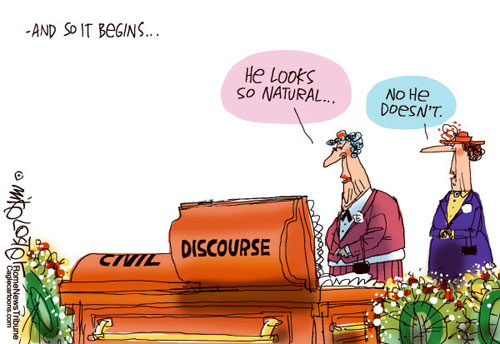
Anyway my friend “commented” in a way that made it obvious he disagreed with the premise I got from the article and said something about how easy it is to sell that vilifying the rich benefits the poor.

I “commented” back that I understood the article the way I describe above. But I also remember this man as having a sense of humor. When I was with him I experienced an interesting mixture of intelligence, sardonic humor and sadness. In my comment I tried to do a bit of humor in this way:

The point of the article is that there are no politicians who situating themselves as advocates of the poor. As far as vilifying rich people, I think of myself as rich, indeed, very lucky to live in the U.S. and have enough to eat and a place to sleep and an instrument to play and books to read and music to listen to. Okay the last few are silly.

Interestingly my friend respond with an emoticon that seemed to make a silly face.

I describe this at length to illustrate how the history of our relationship and talking like a person made our communication more human and less reactionary even though we disagree.

I can see I’m rambling on, but before I stop I want to be sure and talk about two more ideas.

First,  as a parent I have experienced the internalization of my personality in my children. This internalized parent (which I believe we all have to some extent) is a distinct person from myself. In fact I can remember the frustration of witnessing the conversation between my children’s internalized parent(me)  and themselves and not being able to get into the conversation, shut out by my own fixed personality as understood and captured in the heads of my kids.
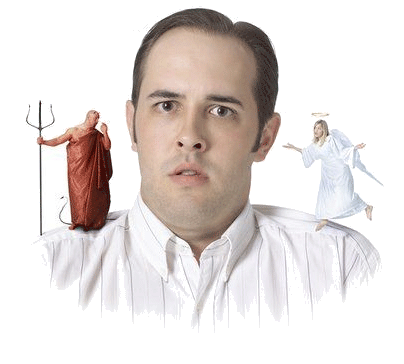
This speaks to a couple of my ideas. First that how we perceive others is primary in our understanding of who they are. And secondly that we are all moving targets. And in each case, if we don’t have the continual feedback of physical presence we are even worse at understanding each other.

All this is a way of saying that I think that the internet is wonderful but it is only a supplement to actually being there.

Lastly, I think that trust is a basic element of relationship. I have difficulty trusting others. But I work at it. If you are my family, you are innocent (several times over) until proven guilty. If you are a colleague I assume you are competent, well informed and well meaning until I catch you out in a misrepresentation or lack of ability you claim to have.

I know that I put a lot of words into today’s blog.  But it’s just a portion of my understanding of this part of being a human.  Something that I keep thinking about and refining my understanding and actions around. Woo hoo!

wii wii wii all the way home


I like this picture. According to the web site where I found it it’s Sawyer Glacier in the Tracy Arm of the Fords Terror Wilderness Area in Alaska. I used it as the background on my desktop just for a change.

Eileen’s Wii arrived yesterday. She was very happy. She spent the afternoon setting it up and bowling and playing baseball.  She intends to check out the fitness games.

I continued planning my upcoming few anthems.  I think I have a plan now for the next 7 weeks.  Today I will go over and pull anthems and make some on the photocopy machine (legally) and prepare for tomorrow.

George Oldroyd (1886-1951)

Yesterday I went over to church and continued to rehearse a lovely piece composed by George Oldroyd. He is roughly the contemporary of the much more famous Ralph Vaughan Williams (1872-1958) and the piece I am playing sounds much like Vaughan Williams.  It’s based on the carol tune (and the sequence for the day tomorrow) called “This Endrys Night.”

It’s a gentle simple tune whose charms are brought out by a harmonization in the hymnal by R.V. Williams (also the first one above). I like the tune so much I wrote my own soprano descant for it for tomorrow.  Oldroyd indicates that his organ setting should start soft and build in intensity. He has subtitled it “A Christmas Paen.” A Paen is a “song of praise or joy.”

This is quite a feat to pull off on my small pipe organ at church. When one only has ten or so ranks of pipes (as opposed to the more normal fifty or so at the minimum) a gradual build-up takes some thought. I’m not complaining about it. I rather enjoy a challenge. First one has to plot out the registration or how you gradually add and subtract certain pipes. Then one learns how to remember what to turn on when as one is playing the piece. I think I can pull it off.

Unfortunately, it’s the prelude and I have to start very quiet and most of the subtlety of the gradual build-up will be lost in the sounds of people getting ready for church. No biggie. I get a charge out of thinking I could figure out how to do it on such a small instrument.

Eileen wanted to go out snowshoeing yesterday. Unfortunately there wasn’t that much snow. It was a good thing her wii came in the mail.

There is a bit more snow on the ground today.  Maybe she and I will go out after she gets home from work.

She has fancy new ones:

A few years ago she took a class and made some that look a lot like this:

The Frame of a Snowshoe in Its Usual Construction, Showing the

I will be using those since she found them way too big for herself.  We will probably be hilarious to watch.

music shop talk & links


I spent most of yesterday working on choosing hymns and anthems for the upcoming six weeks between this Sunday and Ash Wednesday.  Managed to get all of the hymns chosen. The choir stuff is more problematic.  I now have only one soprano, 5 or 6 altos, 3 or 4 tenors, 2 or 3 basses. I put it that way, because people’s attendance continues to be irregular. I have accepted this and am trying to come up with creative solutions.

At the same time my professional integrity insists that I at least consider trying to elevate the tone both by choosing music that is interesting and well-written, but also explicates or relates to the readings of the service.

This is a tall order. But I did find some solutions. I still have about three anthems left to come up with.  I also have to strategize how quickly the choir will be able to pick something up. I have sketched in a little simplified version of a Handel Chandos Anthem (no. 4) for a week from Sunday. This is probably not enough time to learn even an easy two part anthem that is not designed specifically for quick learning. But the anthem is pretty general (The text is “O Worship the Lord” from Psalm 96), so I can probably schedule it later since it is a good piece of music and fits my situation (2 part women and men being feasible).

(When searching for a picture to go with the previous paragraph I ran across a site that sold me a copy of the entire original version picture above for $1.86 (Everynote.com). I had already searched online to try and find more information on this piece in the usual free sites.  Cool beans. I’m printing out a copy in order to study the version my choir will do. I love the internets!

In case you don't get this picture, I see the internet as an incredible jukebox of resources like original music manuscripts and solid information (if you use Harold Rheingold's crap detector method).

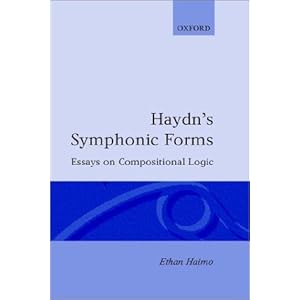
Yesterday afternoon I brought a Haydn trio (Hoboken XV:1 in G Minor).  I have loved Haydn’s music for many years.  I have played several times through his piano sonatas and took an entire class on him from the Haydn expert, Ethan Haimo, at Notre Dame which involved close intelligent scrutiny of many of his works.

I was happily surprised to find many of his trios available as sheet music free online (link to page) and equally happy that the one I chose was such a little masterpiece.  My fellow musicians seemed to also get into it. A good time (first rehearsal after Xmas) to read some new music.

Haydn is a bit easier (not easy but a bit easier) than Mozart and Mozart is a bit easier than Mendelssohn. If I had it to do over again I would have suggested Hadyn before the other two. The piano trios of Mozart and Mendelssohn are wonderful but quite a bit of work of me.

I’ll end with some links I’ve been perusing:

First a couple I picked up off my Twitter Feed and have bookmarked to read:

Utne Reader plugged its article on the relationship of music to increased dopamine levels and decreased depression: “Ode to Joy

Harold Reingold recommended Cathy Davison’s response to the NYT’s article on IPads in schools. Found on the Humanities, Arts, Science, and Technology Advanced Collaboration web site, she remarks: “…[I]f you change the technology but not the method of learning, then you are throwing bad money after bad practice.

The rest of these links I have mostly read through and bookmarked for future reference:

‘The Nutcracker’ Chronicles: Listening to the Score – NYTimes.com

‘Nutcracker’ Questions With Many Answers – NYTimes.com

After Ravages of Time and War, Triage to Save Babylon – NYTimes.com

How the Left Is Left Out – Ralph Nader’s View – NYTimes.com

A Clear and Present Danger to Free Speech – NYTimes.com

The Achievement Test – NYTimes.com “The size of government doesn’t tell you what you need to know; the social and moral content of government action does”

States Seek Laws to Curb Power of Unions – NYTimes.com

How to Listen to Minimalism | Chamber Musician Today

That’s Not Twain – NYTimes.com

Charles Byrne, Irish Giant, Had Rare Gene Mutation – NYTimes.com Genes, not pituitary

wisdom


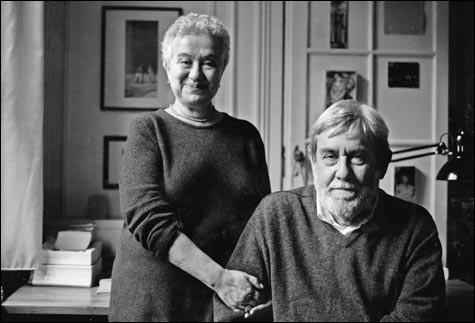
It was this picture that grabbed Eileen’s attention in a new book at the library. This man is Andrew Wyeth the artist.

The book is Wisdom by Andrew Zuckerman.

It is a collection of photographs of people over 65 and some of their views on life.

Dalai Lama

Earlier this same day, I read and then “shared” on Facebook a wonderful homily by the Dalai Lama called “Countering Stress and Depression.”

More wisdom:

Taking a realistic view and cultivating a proper motivation can also shield you against feelings of fear and anxiety. If you develop a pure and sincere motivation, if you are motivated by a wish to help on the basis of kindness, compassion, and respect, then you can carry on any kind of work, in any field, and function more effectively with less fear or worry, not being afraid of what others think or whether you ultimately will be successful in reaching your goal. Even if you fail to achieve your goal, you can feel good about having made the effort.

The Dalai Lama’s words can sound a bit aphoristic, his life, his faith and his clarity are one’s I find inspiring and helpful.

When I sat down last night to look at the book Eileen brought home, at first I thought it was primarily a collections of photographs of the faces of famous old people.

I opened the book and found that there was quite a bit of prose with the first photograph.

So I began reading it. At one point I was so impressed with the following paragraph that I looked around for a sticky to mark it for future reference.

Regarding Chinua Achebe’s first attempt at writing fiction:

“The first attempt I made what when I was a student at the University College of Ibadan, I was told by my teachers from England, ‘This is a good piece of work, but it lacks form.’ And so I said, ‘Okay, what’s form? Can you tell me what form is?’ And the lecturer said, ‘All right, we’ll talk about it next week, I’m going to play tennis right now.’ So we didn’t talk about it next week, we didn’t talk about it next month. Long afterwards she came to me and said, ‘You know, I looked at your story and I think it’s all right.’ So I never learned what form was. Actually she had nothing much to teach me, it was a kind of instruction to me that this is something you have to do on your own. Nobody can teach me who I am. You can describe parts of me, but who I am and what I need, these are things I have to find out myself.”

I loved this paragraph. I added bold above so you could see what sentence grabbed me. At first I thought it might be better phrased for me this way: “Only I can teach myself who I am.” Then I decided that Achebe’s way was pithier and also maybe more clear.

I turned the page and here’s what I saw.

I started chuckling.

One last little bit before I close from Richard Adams (Yes, he’s the author of Watership Down and yes, the book is alphabetical order).

“There was a clergyman who was having a bit of a walk around in the evening and he came to a nice field and there was an old chap who was obviously a gardener, leaning on a gate smoking his pipe. The vicar knew him all right, he was one of his parishioners. Name was Giles. And the vicar looked down at the field and said, ‘Ah, Giles, you and the Lord have made a wonderful difference here.’ ‘Ah,’ said the chap, ‘and you should have seen it when the Lord had it to himself.’ “

Richard Adams.... not a picture from the Wisdom book, but still one I like.

we should therefore be content


Skipped blogging yesterday. Instead I planned the music for this Sunday. This always starts with a look at the readings assigned for the day.  Then I start looking at the hymns that relate via a very intelligent index, a hymnary we used to call it. After choosing hymns, I came up with another easy one rehearsal anthem. Today I must come up with the organ prelude and postlude.


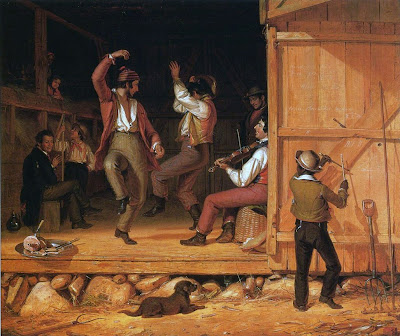
Sara Miles the author put up on this video on Facebook.  Maybe it was my post holiday melancholy but this video really hit me. The jerky smooth movements of these turf dancers seemed to me to capture the combined mood of sadness, outrage and mocking humor.  I think it’s art. Just my opinion.

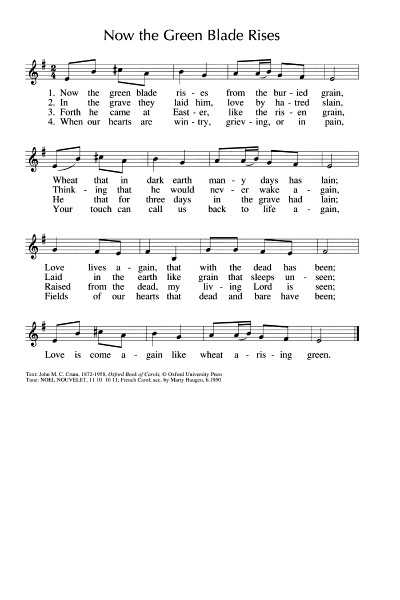
The anthem I chose for Sunday sits a bit high in the range for some of my group of singers. I am down to one soprano, which means most of the singers are altos and basses.  The anthem takes the word of the great hymn, “At the Name of Jesus,” and pairs it with the lovely french medieval carol tune, Noel Nouvelet. This is not it, but you can get an idea of the shape of the original tune:

It is this same carol tune that Fernande Decruck used in her Sonate en Ut # for Saxophone (or Viola) and piano. This is a piece that my friend and colleague Jordan VanHemert introduced me to recently. We messed about with it this summer and he performed it in school this past semester . He had asked me if we could perform it over the Xmas break this year at my church.  We seriously considered it. I even put in many hours trying to prepare myself not to embarrass my self with it on the piano.

Last summer I pointed out to Jordan Decruck’s use of the French carol (Decruck uses it but not does not identify it as the carol in the music).  When he asked about using it this December, I said that even though the origin of the tune is a Christmas one, in American hymnals it is more often paired with the Easter text, “Now the Green Blade Rises.”

Yesterday when Jordan came over to bullshit and do some playing, I had to confess that I was using an anthem based on the tune in the lovely piece he had proposed we use at church. Heh. He took it well.

Jordan looked over my shoulder as I added articulations to the Saxophone part of the anthem we collaborated on and then performed this past Sunday.

Then we played through the first movement of Mozart’s Violin Sonata in A major, K. 305. Since it is in A major it puts it in the unwieldy key of B major for the Bb Soprano Saxophone. I had fun running through it with him, but kept getting excited about the wonderful musical ideas in it and getting a bit carried away and speeding up when I was trying to keep it at a modest tempo for his reading through it for the first time.

We both agreed that it was the Mozart of the wonderful Operas and Grand Partita. Lovely lovely music.

I am returning to my days of solitude. With Jordan’s return to college, I really have no musical colleagues locally. He realizes this I am sure and I think that was part of why he made time for me yesterday even though he is busily preparing to return to school.

It is true that I do have a mild melancholic longing for friendship and collegial relationships. But I have been successfully lowering my expectations on how people connect with me.  It helps to have an excellent companion in my loving wife. But some of it is accepting how difficult it is for many to relate to my love of words and music.

Day before yesterday I found myself playing lots of Haydn, Mozart and Beethoven at the piano. It is such a privilege to spend time with the minds of these men.

I don’t really think of myself as a colleague of these geniuses. Rather there is an intimacy of thought in playing through their musical ideas that resembles being in their presence. Very satisfying.

I also have been basking in beautiful prose of John Crowley’s novel, Little, Big.

I’ll close with some quotes.

As Smokey Barnable walks in solitude and gazes at the windows of the estate he is living on, he thinks:

“He looked toward the inscrutable edge of Edgewood which pointed toward him, windows lit already in the fleeting day; a mask that covered many faces, or a single face that wore many masks, he didn’t know which, nor did he know it about himself.”

I love the way Crowley addresses the complexity of personality in this metaphor.

Are we the multiple voices in our heads throughout our life whose character constantly changes?  Where is the singularity of who we are?  Or does this persistent unchanging selfish imp of personality we all are exist under masks we wear for each other? There is a Proustian echo in this quote for me.

Here’s another passage describing a characters life long romance with sleep and dreams:

“She had always lived her best life in dreams. She knew no greater pleasure than that moment of passage into the other place, where her limbs grew warm and heavy and the sparkling darkness behind her lids became ordered and doors opened; when conscious thought grew owl’s wings and talons and became other than conscious.”

Finally, Crowley himself quotes Cicero. It is a wonderful thought I share with you from the dark Western Michigan early morning:

Hours and days and months and years go by; the past returns no more, and what is to be we cannot know; but whatever the time gives us in which to live, we should therefore be content.

Cicero

pleasantly unstable

brightest

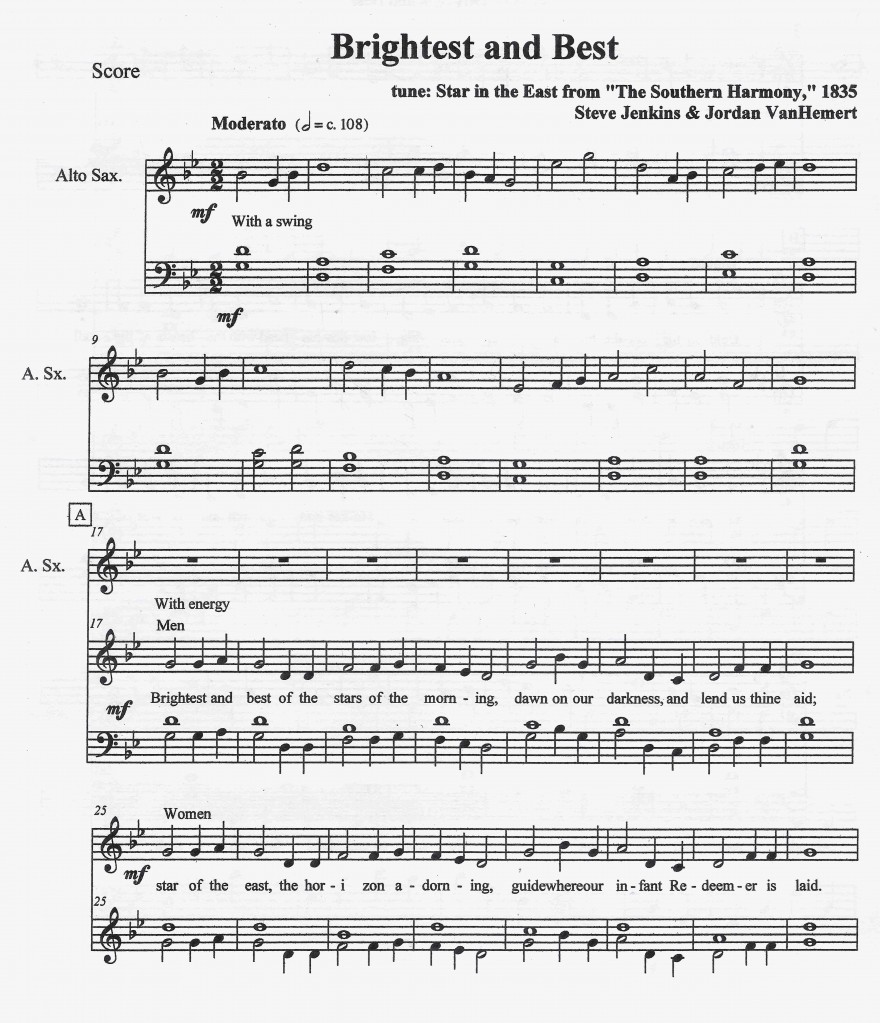
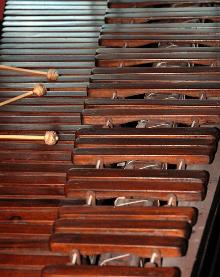
I ended up doing some composing this week. As I mentioned in an earlier post (link to Dec 29 post: “history, dance, and of course music”), I and a colleague did an arrangement for choir, sax, and marimba of an early American tune.

The piece was designed to be learned quickly (i.e. easy).  This seemed to work well yesterday. Despite many absences (a couple people have actually dropped out), the remaining faithful crew easily overcame their anxieties and plunged into this piece yesterday.

The result was very musical and satisfying.  So much so that I have already spend more time this morning with the piece re-editing it to make the final version more representative of what we did and a better composition. I’m still not done. I want to check with Jordan about articulations in the sax part. He switched back and forth between Tenor and Soprano Sax, eventually deciding on Soprano. I preferred the Soprano, but told him I would leave it totally up to him.

Jordan also played on the prelude and postlude.  The prelude was a composition of his called “Todo Para La Familia” (“All for the family”?). This fit in nicely with the readings for the day which talked about the Holy Family running from Herod after Christ’s birth. It also is a beautiful little composition. Along with the postlude (Jordan’s choice of “Isotope” by Joe Henderson), he and I wailed on these tunes and classed up the morning. Just my opinion, heh.

Very satisfying.  These Sundays after Xmas are sort of “low” Sundays. By that I mean attendance and energy are low. The whole service yesterday had a light playful energy.

Eileen and I walked home to a house empty of our guests. I had family visiting this week which was fun.

I had canceled the usual post service choir rehearsal due to the fact that I haven’t picked out any music yet. I spent this time happily in my kitchen making food for Eileen and me (“Orange shrimp” with rice and roasted Parmesan Broccoli…. mmmmm! and all low cal).

I downloaded Henderson playing his tune, “Isotope,”  from Amazon for 99 pennies to play while I cooked.

Joe Henderson 1937 - 2001
Joseph Haydn 1732 - 1809

Also pulled down several of Haydn’s piano sonatas which I have been spending time with at the piano.

unstable atoms

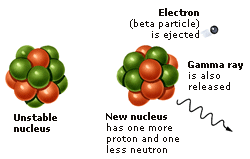
I like this definition of Isotope I found on the web:

isotopes – radiation sources that have an unstable nuclear (center of the atom) composition.

My center is certainly pleasantly unstable.

so many wonderful things in the world


There are so many wonderful things in the world.

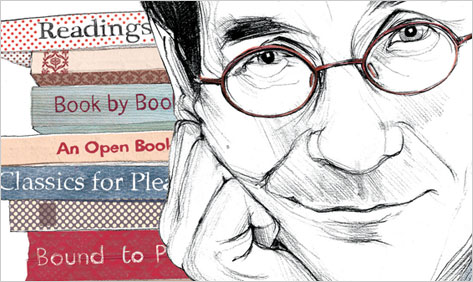
This sentiment is expressed at the very end of Book person, Micheal Dirda’s interview on Lapham’s Quarterly podcast (link scroll down to episode #5 from Nov 23). He is talking about books and I totally agree with this sentiment, but extend to other things like music, cooking and the internet.

I lay in bed earlier and listened to several of the podcasts on the Lapham’s Quarterly audio and video page. I recommend them. I especially liked Pevear and Volokhonsky, the translators of Russian authors. I was so inspired I sent away for their version of Dostoevsky’s Crime and Punishment.

I liked American Voices (#4) with readings excerpts of the writings of Henry Adams, Walt Whitman and Benjamin Franklin,  all three favorites of mine.

If you go to the second page of these podcasts, you’ll find an excellent discussion of Iliad (again a favorite of mine) with Lapham and Caroline Alexander from April 5, 2010.

On the third page one finds an interesting discussion of the history of drinking alcohol by Ian Gately (Dec 1, 2009)

On this same page Donald Kagan talks about Thucydides. (Oct 29, 2009)

This is how I spent the wee hours buy valium ireland this morning.

Then I got up and purchased an MP3 of Prokofiev’s first opus and first piano sonata in F minor. I have been playing this on and off for about a week.  I have done more studying and playing of his A minor piano sonata, but for some reason the F minor has attracted my attention. I like the melodic themes he has come up with and put his little Prokofievian twist on. Of course I play it much slower than the dude in the recording (Boris Berman).

Last night I snuck away to the church and practiced the marimba part my little upcoming composition for sax, choir and marimba we will perform Sunday. Also went over the jazz prelude and postlude and the hymns. I looked at the bulletin and the secretary (or the boss or somebody) dropped one of the hymns I recommended for communion. Weird.

Came home and the group was watching Dexter (not my favorite but a favorite of the rest of the crew). I edited my Marimba piece some more and then trundled off to bed.

Life is good. There are many wonderful things in the world for sure.